

Strategy plans to launch a Bitcoin security program aimed at addressing threats posed by quantum computing and other future security vulnerabilities, said Executive Chairman Michael Saylor during the company’s earnings call on Thursday.
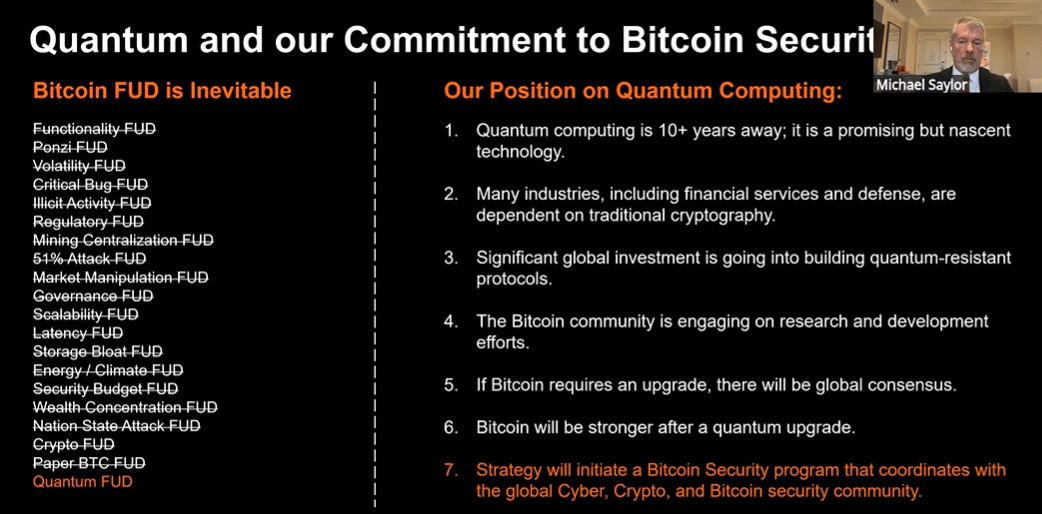
According to Saylor, the program will work with “the global cybersecurity community, the global crypto security community, and the global Bitcoin security committee” to help coordinate research and responses to those emerging risks.
“We think it’s reasonable and appropriate for us to do this, given our large responsibility as a Bitcoin holder. But we want to do it in a very responsible fashion. And we want to make sure that we coordinate with the global cyber crypto and Bitcoin security community, because there are a lot of very, very brilliant minds here,” Saylor said. “There’s a lot of good work being done. And it’s likely that consensus will form and solutions will form at the right time in a responsible fashion.”
Vulnerabilities in Bitcoin’s elliptic curve digital signature algorithm (ECDSA), are susceptible to compromise by Shor’s Algorithm as quantum computing advances.
Research estimates suggest approximately 25% of the Bitcoin supply is currently vulnerable; these ‘at-risk’ holdings primarily consist of early P2PK addresses and reused addresses where the public key has already been revealed on the blockchain.
Addressing concerns about quantum computing, Saylor dismissed them as the latest in a long history of “FUD” that Bitcoin has repeatedly overcome. He argued that while such risks should be taken seriously, investors should not panic or rush into premature technical changes that could create new vulnerabilities.
“We think it’s probably 10 or more years away before there’s a threat. That is the consensus. It’s a promising technology, but it’s still nascent,” Saylor said, adding that many global communities are working on quantum-resistant protocols.
“If Bitcoin requires an upgrade, there will be global consensus. Right now, there isn’t global consensus that existing cryptographic libraries are at risk,” he noted. “You have to be very thoughtful about addressing these risks. And you have to address them at the right time, not too soon, not too late. Because too soon, you probably don’t have the right technology, and you’re over-insuring too late. You accept risks that you shouldn’t.”
“Bitcoin will be stronger if and when that quantum upgrade takes place. And so Bitcoin is upgradeable. And Bitcoin can be upgraded to be stronger,” he emphasized.
Some analysts warn that quantum-capable computers could emerge between 2027 and 2030, and the crypto ecosystem has begun responding to these concerns, including developer proposals such as BIP 360 designed to implement quantum-resistant features in Bitcoin.
The perceived risks have prompted some investors to take defensive positions. Jefferies analyst Christopher Wood removed Bitcoin from his portfolio, citing quantum threats.