
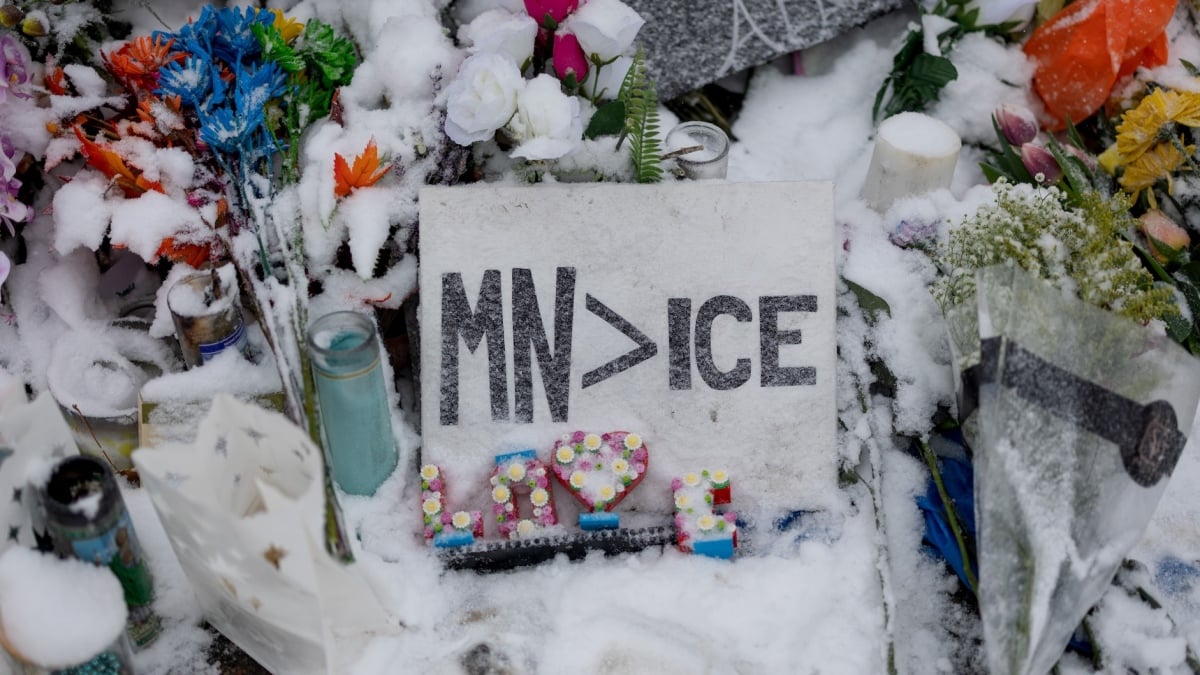
In the ongoing struggle between 2,700 immigration agents sent to Minneapolis this winter, and the large majority of Minnesotans who oppose them, it was supposed to be ICE that had technology on its side.
ICE agents have been using battlefield tech to make arrests. They’ve boasted about using facial recognition (made by Clearview AI as well as the controversial Mobile Fortify app) on neighborhood observers as well as undocumented immigrants. The agency is using 24/7 social media surveillance tools and Israeli spyware that can hack into phones. Palantir, having been awarded $30 million for “ImmigrationOS,” an AI system designed to track individuals for deportation, built a database of real-time locations for ICE’s Minneapolis operation.
“The conglomeration of all these technologies together is giving the government unprecedented abilities,” a lawyer for the American Civil Liberties Union, which is suing the Department of Homeland Security on civil rights grounds, told the New York Times.
But if all that technological terror was supposed to intimidate the people, someone forgot to tell the people — who are feeling more empowered than ever. In part, that’s because every neighborhood in the Twin Cities has developed its own conglomeration of technologies — on regular smartphones.
ICE tracking apps were banned in app stores under government pressure. Nevertheless, the cameras, apps and wikis in their pockets let residents follow, frustrate, and most importantly broadcast ICE’s excesses — including the deaths of Renee Good and Alex Pretti — to a stunned world. Late night hosts, awards shows, and some big names in Silicon Valley took note, even as tech’s top leaders stayed mute.
Now there are signs that this basic-tech coalition is turning the tide. Last week Homeland Security announced a reduction in force, to the tune of 700 ICE agents. The remaining 2,000 officers have seen no let-up from a determined, neighbor-loving, highly-connected populace.
As ICE continues to ramp up operations at breakneck speed across the U.S., many among the two-thirds of Americans who oppose those operations will be looking to learn what worked this winter in the frozen north.
Civil disobedience with high (and low) tech

A woman filming a man flipping the bird to ICE agents.
Credit: Scott Olson/Getty Images
“What we’ve seen in Minneapolis has been hugely inspiring, and there has been a ton of creativity that has come out of the movement,” says Mark Engler, longtime activist and co-author (with his brother, Paul) of This is an Uprising: How Nonviolent Revolt is shaping the 21st Century.
The book’s 10th anniversary edition hits stores this month. In a new afterword on the second Trump administration, the Englers call for “continued evolution in organizing practice … movements in this country must be clearer than ever that their goal is to win over a majority of the public.”
But Minneapolis was way ahead of them; it’s the evolution of organizing around the sentiment of a majority, on steroids. “There are all sorts of new tools and tactics that activists are innovating,” Engler notes, from the high tech of Signal all the way down to low-tech whistles. “The creativity of people coming together, including a ton of people who have never been a part of something like this before, should not be underestimated.”
So how exactly has Minneapolis’ creative resistance to ICE used modern tech? Everything listed below has been a part of the puzzle — starting with the one piece that federal forces have found the most frustrating.
Signal chats and calls: The secret sauce

An ICE resistance organizing sign sits in front of a home.
Credit: Scott Olson/Getty Images
“Over four percent of every single neighborhood is in a Signal chat,” Minneapolis organizer Aru Shiney-Ajay told one labor writer. And that was just the Signal chats her organization, the Sunrise Movement, was tracking as of Jan. 26. The real percentage — Sunrise being only one part of a growing community resistance puzzle — is now very likely much higher. But it’s in the nature of the encrypted app that we don’t know how many: Perfect for a decentralized movement.
Sunrise starts each day creating a new “rapid response” Signal group chat for each neighborhood — and they’re such a hit, you often can’t get in if you’re not an early bird. Shiney-Ajay gave the example of one highly organized St. Paul neighborhood, Frogtown: “Every day by 11 a.m., that chat hits its limit of a thousand people — which is to say that, at any given moment in one neighborhood, there are 1,000 people out patrolling.”
Much of that patrol, according to ride-along reports in the Atlantic and Mother Jones, is in constant voice contact as well. Dispatchers use Signal group calls to stay in touch with “commuters,” volunteer drivers who are directed to where they’re most needed, and offer license plates of suspected ICE vehicles for the dispatcher to look up.
“The calls have the feel of an amateur police radio,” Mother Jones summarized. “Volunteers use quirky aliases and the military alphabet but sometimes don’t remember—a caller might say something along the lines of, “This is Cheese Curd, and I’d like a plate check on Texas plate One Three Four Six Charlie, uh, Robert.””
Mashable Light Speed
Government vehicles are required by law to identify themselves clearly. Looking up license plates of taxpayer-funded vehicles is self-evidently legal. More dubious was FBI Director Kash Patel’s announcement (on a podcast, no less) that he was personally investigating Minneapolis Signal chats. Patel’s investigation met with head-scratching from constitutional scholars on the right as well as the left.
But Minneapolis hasn’t quit on Signal. Nor does it need to worry about the prying eyes of the FBI, according to the Electronic Frontier Foundation, a digital privacy and free speech nonprofit.
“Signal is the best in class encrypted chat app, and yes, it is still secure,” Cooper Quintin, EFF Senior Staff Technologist, told Mashable. “The people who work at Signal can’t read them and the FBI can’t compel them to decrypt them, even with a warrant.”
But Quintin also offered a word of caution: “ICE [or other] law enforcement can and will make their way into large group chats. If you are on a large group chat where you don’t personally know everyone, the safest thing to do is to not say anything that you wouldn’t want read back to you in court.”
Smartphone video: The eyes of the world

A man’s hands holding a smartphone takes video of federal officers.
Credit: Scott Olson/Getty Images
You can see it in the eyes of ICE agents caught in the glare of smartphones: Being recorded from multiple angles is simply unnerving, especially if you’re trying to hide your identity. You can also see it in the other residents, a sense of the phone as a shield — a powerful aid to nonviolent protest. Simply recording video can be a superior alternative to chanting slogans or pumping fists.
“Filming ICE,” Engler says, “can be a way of defiantly showing the authorities that lots of people are watching what they do, and that the community is not intimidated.”
Thousands of Twin Cities residents have undergone constitutional observer training that instructs them to not “interfere, obstruct or escalate a situation” — and the peacefulness of the result is encouraging others. “The communities of people who are showing up for each other are not acting in the way that the administration wants, and that is adding to the power of the popular mobilization,” Engler says. “People are not taking the bait.”
But recording was also what Alex Pretti was doing just before ICE agents shot him. So how can smartphone-wielding observers stay safe? “The biggest question here is physical safety,” the EFF’s Quintin says. For which he advises: Keep your distance from ICE, keep your fellow observers close. Engler theorizes that “a solid wall of observers” could record from closer range, especially with burner phones and cameras that could be snatched.
As for digital safety, Quintin says, “disabling face unlock and fingerprint unlock and having a strong password are important for keeping ICE out of your phone. If you can record while your phone remains locked, for example by using the camera button on the lock screen, that is a better option for safety. If you can leave your phone powered off and record with a different device that is the most safe option.”
Was streaming sidelined?

A masked observer behind a fence in Minneapolis.
Credit: Bridget Bennett/Bloomberg via Getty Images
So far, straight-up video footage of outrageous ICE acts in Minneapolis has grabbed most of the media attention. “Recording might be better than live streaming for preserving the evidence,” notes the EFF’s Quintin. That doesn’t mean live streamers haven’t had a role in the resistance; one journalist was arrested by federal agents while live streaming a church protest. A handful of Twitch streamers can be found tackling the topic. Some streamers have been accused of inflaming the situation.
But in general, this isn’t a streaming situation. Following and recording ICE seems too haphazard a process to alert a wide audience before any encounter; streaming has mostly acted as a way of discussing the issue rather than documenting it.
Free 3-D printed whistles work

An observer backs away from an ICE agent as he holds a whistle in his mouth.
Credit: Scott Olson/Getty Images
The use of whistles to warn of ICE raids began in Chicago in 2025, but has been enthusiastically embraced in Minneapolis. For example, the woman who filmed a crucial video of the Alex Pretti shooting was in the area because she heard whistles.
But those whistles are not all as low tech as you might think. Free 3-D printed whistles are being distributed by multiple individuals and groups around the U.S., with one “whistle crew” claiming to have shipped 200,000 in the first week of February alone. A Whistle Crew Wiki exists to get anyone with a 3-D printer started on fulfilling local requests.
The resistance will be advertised

Activists run billboards that read “Ice agents aren’t about Minnesota law. Illegal conduct can be prosecuted.”
Credit: Adam Bettcher/Getty Images for Democracy for America Action Fund
Smartphones and 3-D printed whistles are not the only 21st century means to alerting the public. One donation-funded group bought time on a bunch of electronic billboards — including one at the Minneapolis airport, above, where ICE agents arrive. “ICE agents aren’t about Minnesota law,” the sign reminds viewers, advising them to call 911 if they see crimes being committed. “Illegal conduct can be prosecuted.”
A made-for-social-media event

A man in front of a line of masked officers.
Credit: Photo by Arthur Maiorella/Anadolu via Getty Images
There’s much about social media in 2026 that’s highly toxic, and the discussions around Minneapolis, rife with AI-based misinformation, are no exception. One analysis at the end of January found that bots were driving more than one-third of online conversations about ICE, both in English and Spanish.
But as for the social media posts coming from ICE observers and protestors in the Twin Cities? In many cases, Hollywood couldn’t have scripted them better. Many residents are so dedicated to observing ICE activities on the fly, they’re grabbing phones and going out in their bathrobes in the snow — including one iconic bathrobed local public radio journalist filming armed federal agents at the scene of a crash.
For a big Hollywood finale, however, there’s nothing better than a choir trying to sing the ICE agents out of town outside their hotel:
This Tweet is currently unavailable. It might be loading or has been removed.
Minnesota. Nice.

Minnesota’s residents are politically active.
Credit: Scott Olson/Getty Images
Ultimately, all the technology in the world won’t help a movement as much as fostering a culture of helping friends and neighbors. And that, as Minnesotans have been telling journalists repeatedly, is the state’s real secret sauce.
No one does civic engagement like Minnesota, with or without smartphones. The state lead the nation in voter participation; around 80 percent of registered voters here participated in 2020, and just a hair under that in 2024. The Twin Cities have strong, proud labor unions, plenty of faith-based activism, and a history of “happy warriors” for civil rights — not to mention the national movement protesting the police killing of George Floyd that kicked off here in the summer of 2020.
“Networks developed in those previous waves of protest have fueled the current round of resistance,” Engler notes. “Ultimately, this creates the conditions where you can win elections, and where all of the institutions of society help to impede the authoritarian program that the Trump administration is trying to impose.”