
Are you looking for the best gold trading brokers to buy/sell gold-based instruments? If yes, you’ve hit the right spot. As the gold broker market is inundated with numerous players, choosing a suitable one based on your requirements can be challenging. In this article, we’ve reviewed and compiled a list of the best gold brokers worldwide. We’ll run you through each platform’s core features, trading costs, advantages, and drawbacks to ease your decision-making process.

10 Best Gold Trading Brokers for 2026
| Gold Broker | Best For | Gold products | Fees | Trustpilot rating |
| Plus500 | Intuitive gold trading app | CFDs and derivatives |
|
4.2/5 |
| Forex.com | Forex trading | Spot gold and CFDs. | Gold spreads between 86 – 202 pips. | 4.6/5 |
| Pepperstone | Superior customer support | CFDs | Raw spreads from 0.0 and fixed commissions from $3.50 per lot, each side. | 4.3/5 |
| Capital.com | CFD trading | Gold spot and futures CFDs. | Dynamic gold spreads between 0.5 – 0.75. | 4.6/5 |
| CMC Markets | Spread betting | CFDs | A minimum spread of 0.39. | 4.3/5 |
| Exness | Swap-free trades | CFDs | Spreads vary across account types and start from zero. | 4.8/5 |
| Interactive Brokers | Unallocated gold trading | Spot gold, gold CFDs, futures, ETFs, and mining stocks. |
|
3.6/5 |
| IG | CFD trading | Spot gold, CFDs, thematic baskets. | A minimum gold spread of 0.3. | 3.9/5 |
| NinjaTrader | Futures contracts | Gold futures | Nominal commissions starting from $0.09. | 3.6/5 |
| Avatrade | Multi-asset trading. | Gold CFDs | Average spread of 0.34. | 4.8/5 |
Top Gold Trading Brokers Reviewed
1. Plus500
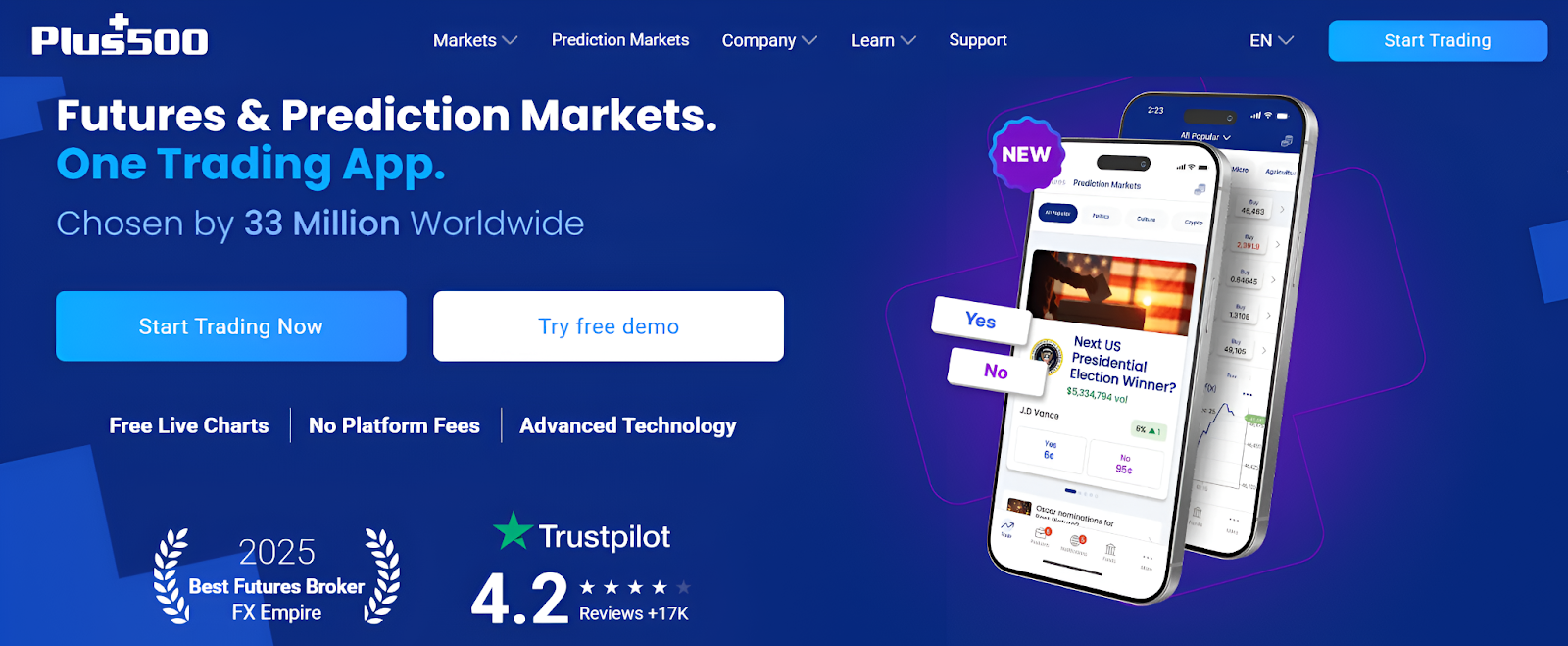
Plus500 is a proprietary technology-based fintech firm registered in the US and serving over 33M users worldwide. It was launched in 2008 as a PC-based online trading platform, catering to both novice and professional traders alike. From contract-for-differences (CFDs) and share dealings to futures and options, Plus500 offers a diverse range of products.
Additionally, Plus500 is authorized to offer futures trading via Plus500US Financial Services LLC, a CFTC-registered company and an NFA member. It enjoys a premium listing on the London Stock Exchange’s Main Market and forms part of the FTSE 250 index.
Key Features
- Futures trading: Plus500 enables you to trade futures on precious and industrial metals, including gold, silver, platinum, copper, and steel. Depending on the contract size and the underlying metal commodity, margin requirements range from $25 to $1,500.
- Demo account: This feature helps you master trading strategies in a risk-free simulated environment that mirrors actual market conditions. Moreover, Plus500 offers you unlimited virtual funds to conduct demo trading.
- Risk management: To help you book profits and curtail losses, Plus500 allows you to set stop loss, trailing stop, and take profit orders.
- Trading academy: The platform features free educational videos and explainer articles to enable users to understand the A-Z of futures markets.
Gold Trading Costs
| Liquidation fee per contract | $10 |
| Standard and E-mini contract charges | $0.89 |
| Micro contract commissions | $0.49 |
| Prediction market contract commissions | $0.01 |
| Inactivity fee | $10 monthly |
| Other charges | Overnight funding, guaranteed stop order, and currency conversion fees. |
Plus500 doesn’t collect data, platform, or routing fees. Deposits and withdrawals are also free. Moreover, you can start trading with a margin of just $100 per side, excluding exchange and National Futures Association (NFA) fees.
Pros |
Cons |
|
|
2. FOREX.com
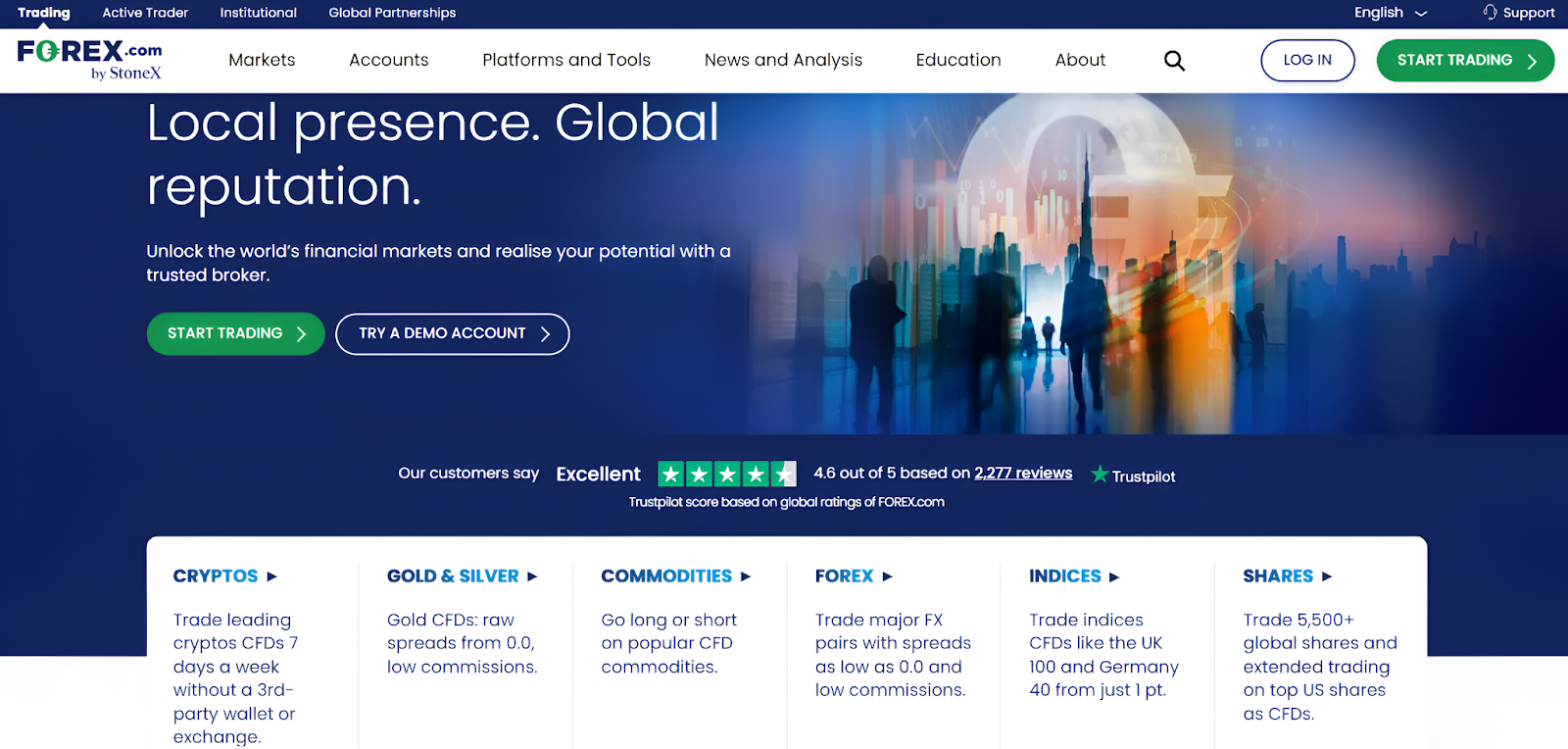
Forex.com is an award-winning forex broker founded in 2001 and a wholly-owned subsidiary of Stonex Group, a NASDAQ-traded firm. It is known for its competitive fees, speedy trade execution, and integrated market research.
For experienced traders, Forex.com offers a MetaTrader 5 (MT5) account. Additionally, it offers a standard account for users who wish to trade via TradingView. If you want extremely low spreads, you can opt for a raw spreads account.
Key Features
- MetaTrader 5: You can open an MT5 account with Forex.com and trade 500+ markets, including gold. It provides access to 20+ premier tools, including 15+ custom indicators and advanced charts. You can even buy, rent, or download 950+ trading bots and 2,000+ technical indicators on the MetaTrader5 Market. Furthermore, you can leverage expert advisors (EAs) to automate trades based on predefined rules.
- TradingView integration: You can trade your Forex.com account on TradingView.com. By doing so, you can access 80+ technical indicators and build your own indicators. You can also overlay charts to compare the price movements of gold with those of the assets it is traded against.
- Advanced trading tools: From AI-powered performance analytics to margin and pivot points calculators, Forex.com offers numerous advanced tools. It also provides actionable insights via Trade Central,
- Active Trader Program: High-volume traders with standard accounts are eligible for the Active Trader program. It offers cash rebates, one-on-one dedicated support, and exclusive VIP benefits, effectively lowering your trading costs by up to 15%.
Gold Trading Costs
- Spreads: When trading through Forex.com, you need to incur both fixed and variable spreads. As of February 24, 2026, the fixed spreads for popular XAU pairs are wide, ranging between 86 and 202 pips. In general, spreads fluctuate as per prevailing market conditions, volatility, and available liquidity.
| XAU trading pair | Spread (pips) |
| XAU/USD | 86 |
| XAU/CHF | 126 |
| XAU/EUR | 140 |
| XAU/AUD | 178 |
| XAU/JPY | 202 |
- Rollover rates: Forex.com applies rollover rates to open trades on weekdays at 5 pm ET. The applicable rate varies across XAU pairs and position type (long/short). At the time of writing, the platform doesn’t levy rollover rates for Gold Mini. The rates range from -7.44 to -1.51 for long positions and from 0.11 to 5.90 for short positions.
- Inactivity fees: If there is no trading activity for 12 months, you must incur a monthly inactivity fee of $15.
Pros |
Cons |
|
|
3. Pepperstone
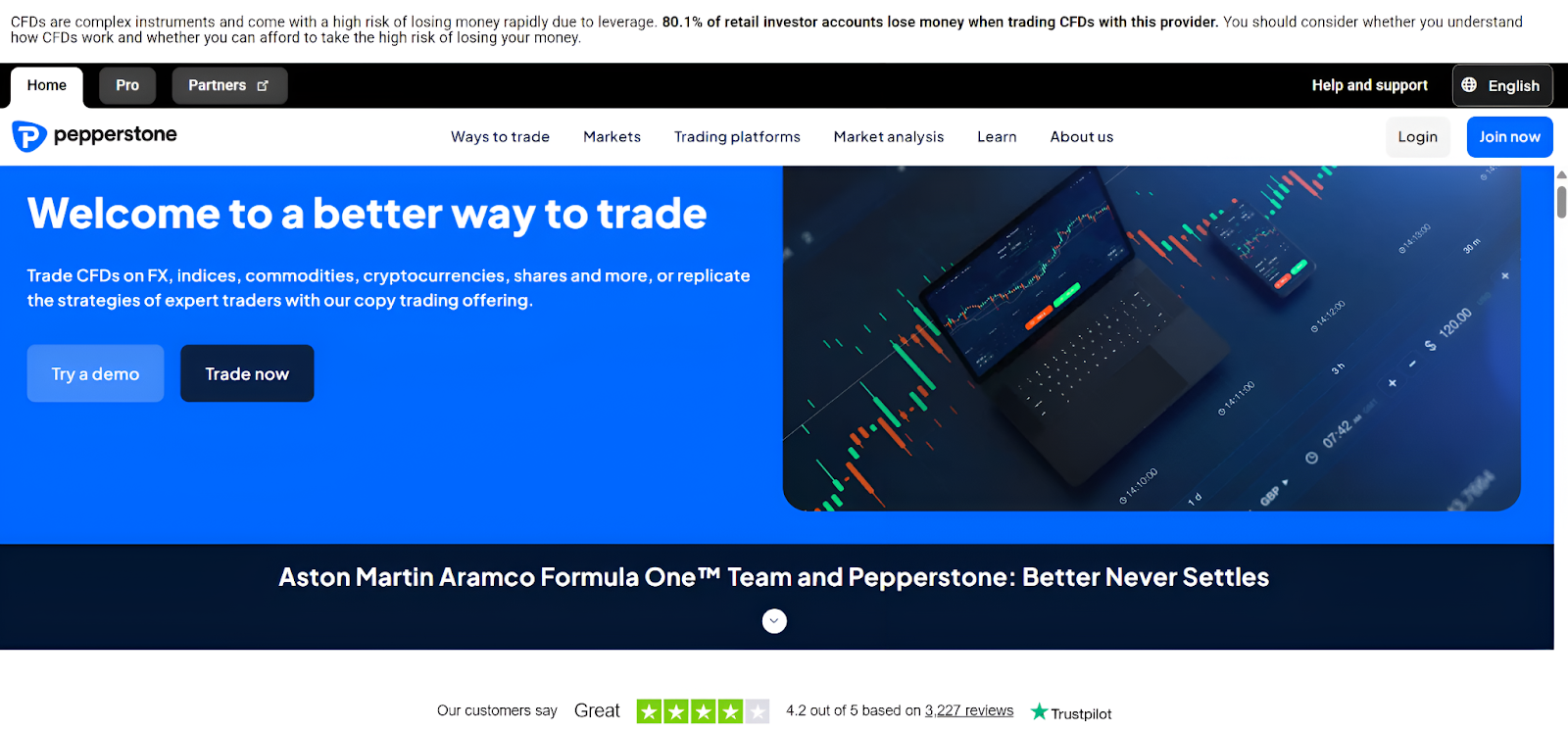
Established in 2010, Pepperstone is an Australia-based gold broker, serving over 830K users across 150+ nations. It has 10 global offices and processes over AU$1 trillion in trades monthly.
Moreover, Pepperstone possesses ISO 27001, SOC2 Type 1, and CSA STAR level 1 and 2 certifications. It holds user funds in segregated accounts and is regulated by coveted bodies like DFSA, CMA, ASIC, CySEC, and FCA.
Key Features
- High leverage: Pepperstone offers a leverage of up to 200:1 to retail traders and up to 1000:1 to professional traders.
- Multiple trading platforms: If you desire ultra-tight spreads and lightning-fast trade execution, you can choose TradingView, MT4, or MT5 with Pepperstone. The platform boasts a 99.5%+ fill rate, no dealer intervention, and transaction speeds starting from 50 milliseconds.
While both TradingView and MetaTrader offer smart trading tools and numerous indicators, MT5 is the best for algorithmic traders. It enables trading automations, back-testing, and more customizations. Moreover, it offers MQL5 programming, advanced chart types, cutting-edge analytics, and a higher number of indicators and order types. If you want a simpler interface, opt for Pepperstone’s trading platform.
- Copy trading: With Pepperstone, you can seamlessly replicate the strategies of expert traders and signal providers.
- Cash-settled commodity CFDs: You can trade gold CFDs with spreads as low as 0.1 pts. Besides, you can trade CFDs for silver, copper, crude oil, natural gas, coffee, cotton, sugar, and cocoa.
Gold Trading Costs
- Spreads: If you possess a standard account, all costs, except overnight funding, are included in the spread. If you prefer commission-based pricing on margin FX, opt for a Razor account. It offers raw spreads from 0.0 alongwith fixed commissions starting from $3.50 per lot, per side. Currently, the standard and razor minimum spreads for XAU/USD are 0.05, and the average spreads are 0.25.
- Rollover rate: All positions that remain open at 5 pm NY on trading days are subject to swap adjustments. Different swap rates apply to rollovers over weekdays and weekends. The rate also varies based on the instrument being traded.
Pros |
Cons |
|
|
4. Capital.com
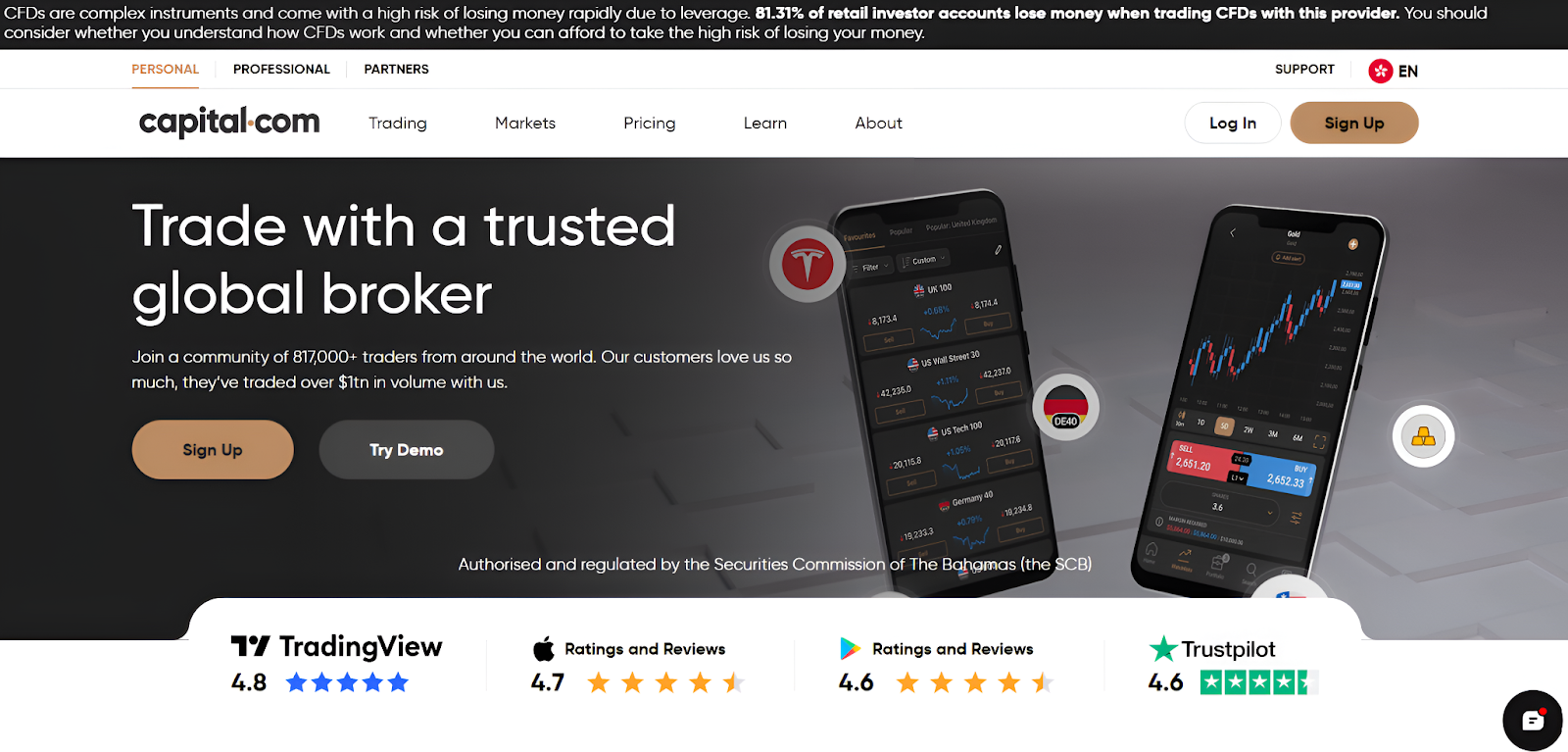
Capital.com is a reputable platform that was recently adjudged as the “Best CFD broker” by BrokerChooser. It has also won accolades for its trading account, easy-to-use interface, and competitive fee structure from Good Money Guide and ForexBrokers. Launched in 2016 in Cyprus, Capital.com currently serves 817,000+ traders globally. It has also established offices in multiple countries, including the UAE, Australia, Poland, Bulgaria, the Bahamas, Lithuania, and Italy.
An impressive aspect of Capital.com is the array of security features the platform has implemented. These include segregated accounts, negative balance protection, and guaranteed stop losses. Moreover, the platform is regulated by the Securities Commission of the Bahamas (SCB).
Key Features
- CFD trading: Capital.com enables you to trade CFDs on 5,000+ markets, including commodities markets. You can also utilize a leverage of up to 200:1 on your CFD trading account to amplify your potential profits.
- Speedy deposits and withdrawals: The platform processes 98.62% of withdrawals within 24 hours. It also enables you to deposit funds swiftly and securely.
- Trading tools: To help users estimate their returns beforehand, Capital.com offers a variety of tools, including a CFD calculator and demo trading.
- Trading platforms: Capital.com has built an in-house web interface equipped with 100+ technical indicators, drawing tools, and unlimited watchlists. Its mobile app is also responsive, enabling you to track market movements and receive price alerts anytime, anywhere. If you want advanced charting tools, indicators, or analytical objects to study price trends, opt for TradingView/MT5 with Capital.com.
Gold Trading Costs
- Inactivity fees: If you don’t use the account for more than a year, you must pay an inactivity fee of $10 per month.
- Spreads: These are dynamic costs that fluctuate as per market conditions. Currently, the spread for gold spot is between 0.50 – 0.75, while that for gold futures is 0.70. Every month, you’ll get a portion of your spread as a rebate.
- Currency conversion fees: As of February 2026, you need to incur 0.7% of the spot forex rate. If you’re a professional client, you’ll be charged 0.5% of the conversion rate.
- Overnight funding adjustment: For gold futures, the overnight funding adjustment rate is -0.01096%. In the case of spot gold, the rate is -0.01620 for long positions and 0.00798% for short positions.
Pros |
Cons |
|
|
5. CMC Markets
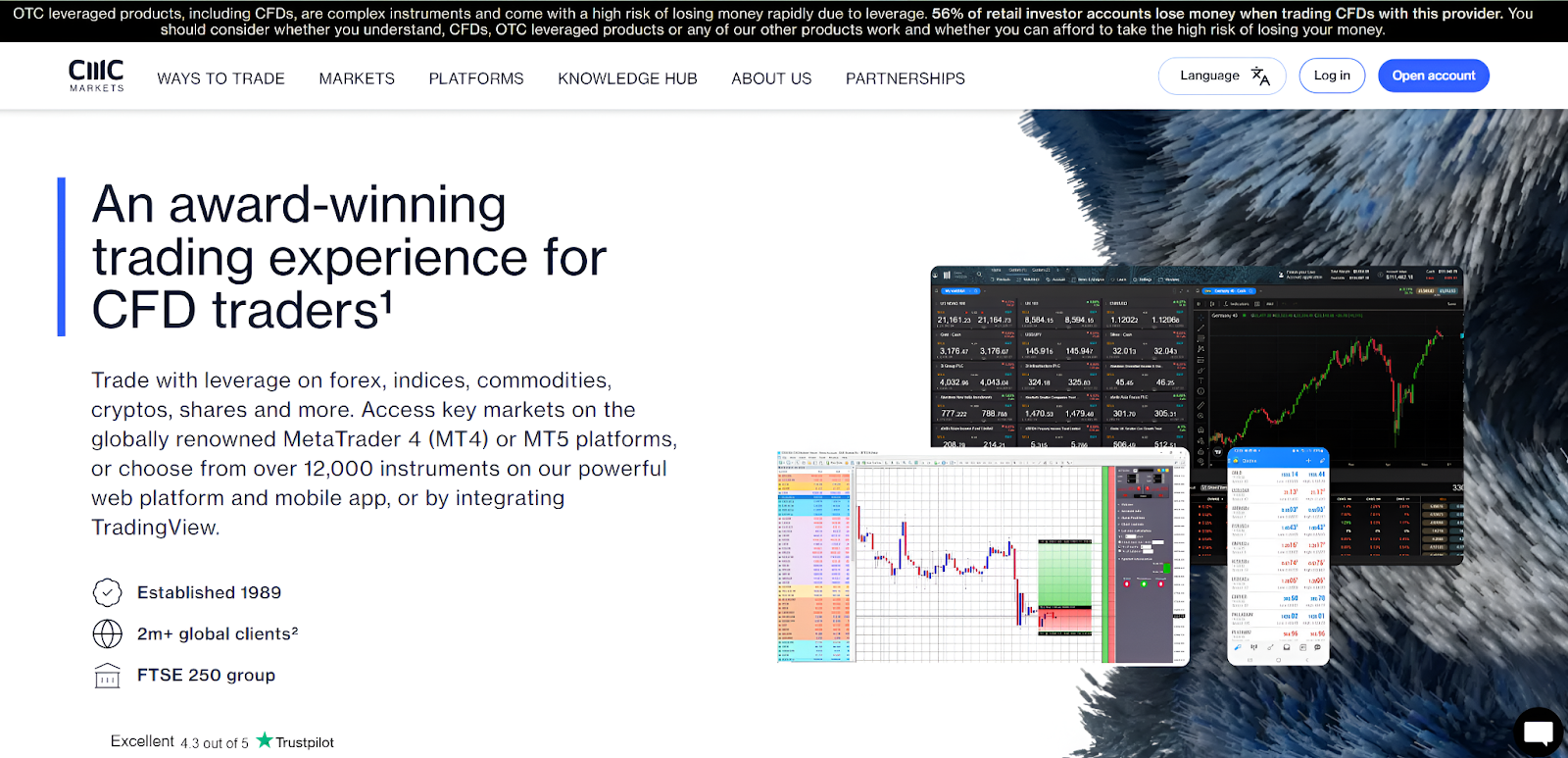
Launched over 35 years ago in 1989, CMC Markets is one of the oldest gold brokers in the world. It has 12 global offices and a registered user base of over 2M traders worldwide. It is well-known for its customer centricity, high-quality services, and competitive spreads. Moreover, it is a member of the FTSE 250 group and is regulated by renowned bodies like MAS and BaFIN.
Key Features
- CFD trading: You can trade CFDs on 12K+ instruments, including indices, forex, commodities, cryptocurrencies, and shares. It offers zero spreads with FX active accounts, maximum retail leverage of 1:200, and 0.01 micro lot trading.
- Blazing-fast execution: CMC Markets has established a London-based server to ensure deep liquidity and deliver ultra-fast execution.
- Free indicators and EAs: To help users sharpen their technical and fundamental analysis skills, the platform provides a suite of free premium indicators and EAs.
- Cutting-edge technology: CMC’s standard CFD account is a next-generation platform powered by its proprietary technology. It is available on both desktops and mobile devices and can be linked to TradingView.
- MetaTrader 4 and 5: If you want to hedge your positions, access EAs to automate trades, or enjoy unrestricted trading or scalping, explore MT4. If you require more order types, timeframes, pre-built indicators, and economic calendars, MT5 is better.
Gold Trading Costs
- Spreads: The minimum spread for gold CFDs is 0.39, and the margin rate is 0.5%.
- Overnight holding cost: Based on the direction of your gold trade, your holding cost or overnight rollover fee may be positive or negative.
- Guaranteed stop-loss orders: If you add a GSLO to your transaction for a premium, you must incur a fee. This fee is calculated using your trade size and premium rate. If the GSLO is not triggered, CMC will refund 100% of your fees.
- Market data fee: To view market/price data related to share CFDs, you must choose a monthly subscription plan.
- Inactivity fee: If your account remains dormant for a year, you must pay a monthly fee of £10. However, if your account has a zero balance, this fee won’t be deducted.
- Rollover costs: You can keep a trade open beyond its expiry date by rolling over the forward position. If you do so, your profits/losses will be realized, and you’ll enter the new trade at mid-price. Moreover, you save 50% on trading charges.
Pros |
Cons |
|
|
6. Exness
Exenss is a leading multi-asset broker in the CFD market. Launched in 2008, Exness has 13 global offices and holds regulatory licenses from various bodies like the FCA, CBCS, FSC, and CySEC. It is also PCI: DSS-certified and offers world-class security and data protection. Moreover, Exness offers 24/7 multilingual support in 14 languages via email, online chat, and phone.
Key Features
- Swap-free trades: Exness doesn’t collect overnight holding fees for XAUAUD, XAUEUR, and XAUUSD pairs.
- Gold CFDs: You’ll get competitive spreads on XAUUSD and precise executions despite market volatility. Also, spreads remain tight and steady even during market events.
- Security: Exness has implemented risk management features such as negative balance protection and stop-out protection. Therefore, you won’t lose more money than you deposited, and your positions won’t be automatically closed due to inadequate margins.
- Diverse offerings: Apart from gold CFDs, you can trade silver, aluminum, copper, lead, palladium, zinc, and platinum CFDs. If you want to diversify your portfolio, you can explore crypto, stock, index, and forex CFDs.
- Trading platforms: You can trade metal CFDs on the MT4 and MT5 platforms via desktops, smartphones, or the web. You can also explore the high-performance Exness mobile app and web terminal to enjoy a streamlined trading experience.
Gold Trading Costs
- Standard and Standard cent accounts: These are commission-free accounts, offering unlimited leverage and a maximum lot size of up to 200. You need to make a minimum deposit of $150. Spreads start from 0.2 pips and 0.3 pips for standard and standard cent accounts, respectively.
- Pro account: If you want instant executions, zero commissions, and low spreads starting from 0.1 pips, the Pro account is the best. However, you must deposit at least $2,000 to trade using this account.
- Zero account: This account offers zero spreads on the top 30 instruments, including gold. However, you must pay a minimum commission fee of $0.05 per lot per side.
- Raw spread account: If you want to enjoy the lowest spreads, choose a raw spread account. It entails a fixed commission of up to $3.50 per lot, each side.
- Spreads: Spreads vary across account types and XAU pairs. The average spread of XAU/USD ranges between 9.7 and 36.
Pros |
Cons |
|
|
7. Interactive Brokers
Founded in 1978, Interactive Brokers (IBKR) is a regulated securities dealer, recognized for its diverse offerings, financial strength, clearing services, and ultra-fast trade execution. Headquartered in Greenwich, USA, IBKR serves investors across 170+ countries. It has global offices at multiple locations, including the US, Canada, and Australia. Lastly, the platform is regulated by coveted bodies like FINRA, SEC, NYSE, and FCA.
Key Features
- Third-party integrations: Traders can seamlessly integrate their IBKR data with third-party service providers. These include portfolio management, order tracking, employee compliance, and post-trade allocation tools and software.
- Unallocated gold: IBKR enables qualifying investors to participate in London’s unallocated market and access UK spot gold/silver price movements. It helps you hold a claim over precious metals without owning physical gold/silver bars. If the price of gold traded in the London bullion market rises, you’ll earn cash from IBKR (IE), and vice versa.
- Metal CFDs: These instruments are tradeable 23 hours daily, granting you flexible exposure to global markets. Moreover, IBKR charges a nominal overnight financing rate of benchmark +/- 1.5% for precious metals.
- Advanced tools: IBKR offers powerful tools like Trader Workstation to create combination orders, manage futures positions, and evaluate index arbitrages.
Gold Trading Costs
- Gold futures: Interactive Brokers offers gold futures contracts denominated in USD, CAD, CHF, JPY, and CNH. Based on your monthly trading volume, the tiered fee ranges between $0.05 – $0.15 per contract. Besides, you must incur a fixed charge of $0.15 for each contract.
- London gold: Whether you trade spot gold or gold CFDs, you need to pay a commission. Also, metal CFDs have a fixed pricing structure.
| Order amount (USD) | Commissions |
| 0 – 500,000 | 1.5 basis points of the total trade value |
| 500,000.01 – 1,000,000 | 1 bps of trade value |
| >1,000,000 | 0.7 bps of trade value. |
- Storage costs: For London spot gold positions, the platform collects an annual storage fee of 0.10% of your position value.
- Borrow fees: When you short gold, you’ll be charged a borrowing fee based on your position size. It comprises a benchmark USD rate plus IBKR markup.
| Balance position size (USD) | Borrow fees |
| 0 – 1,000,000 | 4.64% (BM + 1%) |
| 1,000,000.01 – 10,000,000 | 4.14% (BM + 0.5%) |
| >10,000,000 | 3.94% (BM + 0.3%) |
Pros |
Cons |
|
|
8. IG
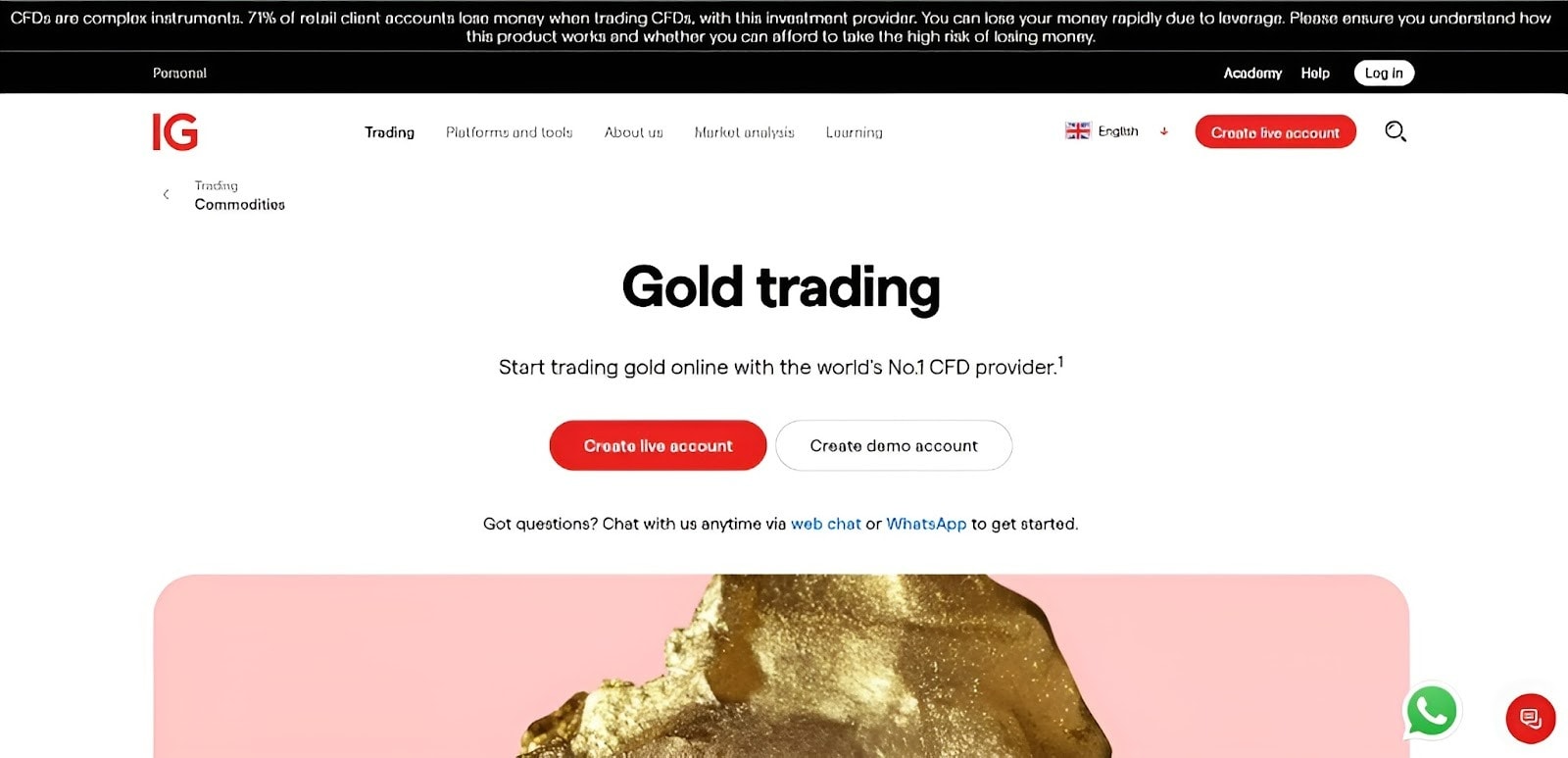
Touted as the #1 broker for CFD trading, IG enables you to access 17,000+ markets 24/7 from a unified platform. Established in 1974, the platform is licensed to conduct digital asset and investment businesses by the Bermuda Monetary Authority. Moreover, IG safeguards your money in segregated accounts and ringfences it from creditors.
Key Features
- Trading platforms: In addition to MT4, MT5, and TradingView, IG offers ProRealTime and L2 Dealer. ProRealTime is a web-based charting software integrated with the IG trading platform. Conversely, L2 Dealer is a direct market access (DMA) platform for trading CFDs on shares and forex. It features a sentiment analysis tool that helps you understand whether market participants are currently bullish or bearish.
- Trading analytics tool: This tool evaluates your trading history, including successful and unsuccessful trades. It identifies your trading errors, enabling you to improve your future performance. Moreover, the analytics tool summarizes your net returns from closed positions, including fees and other adjustments.
- Free trading signals: You’ll get actionable trading signals created by Autochartist and PIA-First in real time for indices, commodities, and forex.
- Intuitive trading charts: IG leverages HTML5 technology to monitor live market developments. It provides 32+ customizable indicators and 19+ drawing tools to help you perform technical analysis.
Gold Trading Costs
- Spreads: The minimum spread for trading CFDs on spot gold is 0.3.
- Overnight funding fee: If your cash CFD positions remain open beyond the daily cut-off time, you must pay the overnight funding fees. The platform also adds a nominal admin fee to this cost.
- Guaranteed stop and knock-out premiums: IG charges knock-out and guaranteed stop premiums of 0.3 and 0.5, respectively. By paying these charges, you can safeguard your positions from slippage.
- Other charges: IG collects additional fees for DMA trading, live price data feeds, ProRealTime charts ($40 monthly), account documentation, and currency conversions.
Pros |
Cons |
|
|
9. NinjaTrader
NinjaTrader is a US-based gold broker founded in 2003. It provides cutting-edge trading software and brokerage services, especially to active futures traders. In January 2026, it expanded into Europe to meet the growing demand for retail futures. Currently, NinjaTraders is registered as a Futures Commission Merchant with CFTC and is an NFA member.
Key Features
- Micro futures contracts: NinjaTrader offers byte-sized gold futures contracts, 1/10th the size of a standard contract. It imparts greater flexibility to scale, enabling you to enter/exit positions quickly. It also provides access to higher leverage and lowers your trade size risk.
- Trading platform: NinjaTrader’s flagship desktop platform offers a fully customizable experience. It offers standout features such as multi-monitor support, advanced charting, and access to 1,000+ add-ons and trading apps. If you want to buy/sell futures over the web, NinjaTrader provides a cloud-based platform compatible with any PC or MacBook. If you want to trade on the go, the platform’s mobile app is optimized for Android/iOS phones.
- Trading simulator: You can hone your trading skills and practice automated strategies in a simulated environment. It offers a free backtesting engine and enables you to replay historical market data tick-by-tick.
- NinjaTrader Pulse: It indicates overall market sentiment, including pressure gauges and actionable insights.
Gold Trading Costs
- Free plan: If you don’t subscribe to any paid plan, you need to pay commissions per side. NinjaTrader levies a commission of $0.39 for micro contracts and $1.29 for standard futures.
- Monthly plan: You must incur a monthly subscription fee of $99. However, your commissions are reduced to $0.29 and $0.99 for micro and standard contracts.
- Lifetime plan: You need to pay a one-time fee of $1,499. If you purchase the lifetime subscription, you can enjoy the lowest commission: $0.09 (micro) and $0.59 (standard).
Pros |
Cons |
|
|
10. AvaTrade
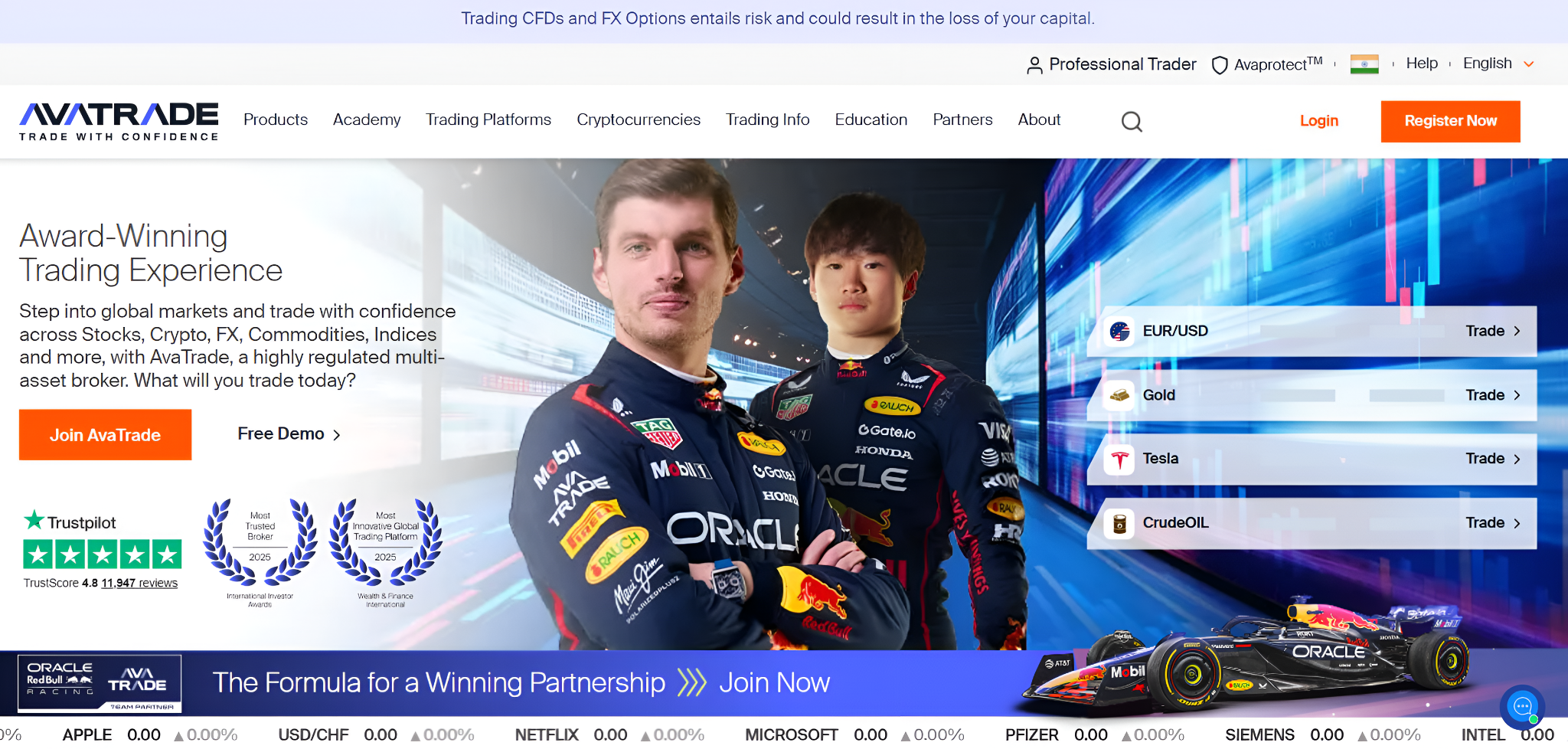
AvaTrade is an Ireland-based online trading broker with regional offices in multiple countries, including Australia, Chile, Italy, and Poland. It serves 400,000+ customers worldwide and is known for its wide asset selection and security features. It stores client funds in segregated accounts and has established AvaProtect, a cutting-edge risk management tool.
Key Features
- Gold CFDs: Avatrade allows you to trade CFDs on gold with a leverage of up to 400:1. It also facilitates short selling and auto trading.
- Trading signals: The platform provides detailed signal analysis and actionable buy/sell recommendations. These signals are offered by Trading Central and tailored to your needs.
- Vast product range: From CFDs, stocks, and indices to derivatives, cryptocurrencies, and commodities, you can trade a variety of assets with Avatrade.
- Academy: Whether you’re a beginner, intermediate, or advanced trader, the Avatrade Academy offers extensive educational resources for different trading styles.
- Regulation: Avatrade is regulated by multiple organizations, including the Central Bank of Ireland, ASIC, and the Financial Superintendency of Colombia.
- Avaprotect: It allows you to insure a specific trade against losses of up to $1M over a chosen period. At the end of the protected period, the platform reimburses you for your losing trades.
Gold Trading Costs
Apart from buy/sell spreads, Avatrade imposes the following fees:
- Overnight premium: You must pay an overnight funding fee for holding positions beyond a certain time.
- Inactivity fee: If you don’t use your Avatrade account for three consecutive months, you’ll be charged an inactivity fee of $50 monthly.
- Administration fee: You must pay an additional annual inactivity fee of $100 if your trading account remains unused for over 12 months.
Pros |
Cons |
|
|
How We Ranked the Best Gold Trading Brokers?
To identify and rank the best gold brokers, we first joined trader communities on social media platforms like Reddit, X, Telegram, etc. This way, we were able to obtain collective feedback on various brokers. For deeper insights, we evaluated customer feedback on Trustpilot. Based on these inputs, we shortlisted a few gold trading platforms for further analysis.
Next, we created an account on each shortlisted platform to gain hands-on experience with their features, products, and services. Our personal experiences helped us understand each broker’s advantages and pitfalls, enabling us to deliver an unbiased review.
Overall, we assessed the brokers based on multiple criteria, including core features, pricing, product range, regulatory compliance, security, and customer support. We assigned a score to each criterion and arrived at the final rating by adding up the scores. Based on the total score, the platforms were arranged in descending order. The platform receiving the maximum points was ranked #1. While we continuously evaluate new brokers, we periodically revisit the existing ones to update our rankings.
How to Choose a XAU/USD Broker and Trading Platform?
1. Gold Trading Regulation
Before registering on any platform, audit its security features and regulatory compliance. Usually, the top-tier brokers are licensed by renowned market regulators such as the SEC, FINMA, CySec, CFTC, and FCA. Additionally, ensure the broker is authorized to offer services in your jurisdiction.
2. Gold Trading Platforms and technology
The user interface and the underlying software play a key role in delivering a seamless trading experience. Many brokers use proprietary technology, meaning the trading platform, tools, and software have been developed in-house.
Some brokers also integrate with MetaTrader and TradingView by procuring server licenses or connecting via APIs. Therefore, you can easily link your account with these trading terminals and leverage their features to maximize your returns. In general, choose brokers offering a user-friendly trading platform with advanced features, including cutting-edge charting tools and customizations.
3. Trading Tools and Features
When choosing a broker, check whether they offer technical tools like candlestick charts, RSI, MACD, moving averages, Fibonacci extensions, etc. Assess whether the platform supports scripting languages like Pine Script to help you create custom indicators. If you’re an algorithmic trader, look for brokers offering trading automation software or pre-built bots.
Additionally, evaluate the platform’s risk management features, including profit & loss calculators, stop-loss/take-profit orders, trailing stops, etc. Add-on features like live news feeds, forex heatmaps, economic calendars, and other sentiment analysis tools help you forecast price direction.
4. Account Types
The highest-rated brokers typically offer multiple account types, catering to users with varying levels of trading experience. Many platforms predominantly offer three types of accounts: micro, standard, and VIP/Platinum.
Micro accounts are perfect for small traders with deposits below $1,000 or novices who have just begun their trading journey. Standard accounts provide access to more features, including margin trading. However, their minimum deposit requirements are higher, around $10,000.
VIP/Platinum accounts are designed for high-volume traders, experienced users, and institutional investors. Their minimum lot size and deposit requirements are usually above $25,000. Moreover, VIP traders get exclusive perks such as invites to special events and priority support. However, brokers may offer the lowest leverage and specify the highest margin requirements for VIP users to reduce overall risk exposure.
5. Deposit and Withdrawal Methods
Select a platform that supports multiple payment options, including bank transfers, credit/debit cards, e-wallets, and cryptocurrencies.
6. Customer Support
You should be able to contact the customer support team via multiple channels, such as e-mail, live chat, and telephone. Also, the response time should be faster, meaning the support team must resolve your queries promptly.
What Is Gold Trading and How Does It Work?
Gold trading involves speculating on future price movements without owning the physical metal. Instead of purchasing gold bullion, traders take long/short positions in financial instruments that track gold’s market value.
Gold prices fluctuate due to factors influencing demand and supply dynamics. These include macroeconomic indicators, monetary policies, geopolitical events, and overall market sentiment. Technical indicators also play an important role, helping traders identify potential reversals and breakout opportunities.
While you can trade gold instruments independently, using a broker offers numerous advantages. You gain access to a broad range of asset classes, including gold, along with advanced trading tools and features. Many brokers also provide leveraged trading, enabling you to control larger positions with less capital.
Ways to Trade Gold
- Spot gold: The spot price of gold refers to the current market price at which gold can be bought/sold for immediate delivery. In retail trading, spot gold trades are usually cash-settled. By trading spot gold, you gain exposure to bullion without taking ownership of the physical asset.
- Gold contract-for-differences (CFDs): They’re derivative instruments that allow you to speculate on gold price movements without taking ownership of physical bullion. CFDs are risky as they’re usually traded on margins, amplifying your potential gains as well as losses.
- Gold futures: Gold futures are standardized derivative contracts that involve buying/selling gold at a predetermined price on a specified future date. A long position benefits if the spot price of gold exceeds the contract price at expiration. A short position profits if the spot price is lower than the contract price at maturity.
- Gold options: Option buyers have the right, but not the obligation, to buy/sell gold at a predetermined price on or before expiry. If you buy gold options, your losses are limited to the premium paid, even if the market moves against you.
- Gold stocks: They’re shares of companies involved in gold mining, production, or related activities.
- Gold ETFs: ETFs track the price of physical gold or the movement of a basket of publicly traded gold stocks.
How to Set Up a Gold Trading Account
Step 1: Choose Your Broker
Choose a suitable broker based on your goals, preferences, trading experience, risk tolerance, and budget. Before registering, double-check if the broker is licensed to offer services in your location and has implemented robust security.
Step 2: Complete the Registration
Visit the chosen broker’s official website. Click the “Sign up”, “Register”, or “Open Account” tab. Enter personal and contact details, including your name, email, location, and phone number. Create a user name and password. Select the correct account type (e.g, individual/business, standard/MetaTrader5). Fill out the application form completely, including your tax information.
Step 3: Verify Your Identity
After signing up, complete the know-your-customer (KYC) process. Submit a government-issued identity and address proof, such as a passport, driver’s license, national ID, etc. Some platforms also require users to furnish income proofs like pay slips, income tax returns, or bank statements. Finally, upload a selfie to complete facial recognition.
Step 4: Fund Your Account
Once you finish identity verification, fund your account. You can deposit fiat currencies or cryptocurrencies, depending on the platform’s specifications. Choose any supported payment method, like Google/Apple Pay, bank transfer, or PayPal, to make the deposit.
Step 5: Start Trading Gold
Now you’re ready to trade gold and other supported assets like stocks, indices, CFDs, oil, and ETFs on the platform.
Gold Trading Strategies for New Traders
- Support and resistance trading: Use technical indicators like Fibonacci retracement or extensions to identify support/resistance levels. Usually, beginners should buy gold near strong support levels as the market momentum may be turning bullish. Contrarily, they must sell near a resistance level, especially when the gold price is struggling to breach it.
- Breakout trading: If you’re an active trader, open a position during the early phases of a trend. When the price breaches a resistance level, go long. Conversely, when the price falls below a support level, go short.
- Trend following: Analyze market trends using simple tools like moving averages. Trade in the direction of the trend, rather than assuming an opposite position. So, go long during bullish phases and go short during bearish phases.
- Buy and hold: Purchase gold at the current price and hold it for an extended period to profit from its long-term growth.
Common Types of Gold Trading Orders
1. Market Order
When you place a market order, your broker will immediately execute the order at the best available current price.
2. Limit Order
You can place a limit order when you want to execute the trade at a specific price. If you set a limit buy order, your broker will fill the order at or below the specified price. For limit sell orders, the broker fills the order at or above the pre-defined price.
3. Stop Order (Stop-Loss)
Stop orders help curtail losses by allowing traders to specify a stop-loss price. When the price of gold reaches the aforementioned price, the order will be executed like a market order. Your broker will buy/sell gold at the best available price in the current market conditions.
4. Fill or Kill Order
A fill or kill order comes in handy if you want to execute a trade at a specific price right away. If your broker fails to fill the order immediately after three consecutive tries, the order is automatically cancelled/killed.
5. Good Till Canceled (GTC) Order
A GTC order can be helpful if you’re willing to wait until your order gets filled at your desired price. Unless you cancel it yourself, the order remains open and would be automatically executed when gold reaches your desired price.
6. Good Till Date (GTD) Order
A GTD order remains active in the market until the execution date specified by the trader. If the order isn’t filled by the stipulated date, it gets automatically cancelled.
What to Avoid When Choosing a Gold Broker?
1. Unregulated Brokers
Unregulated brokers operate without oversight from reputable authorities. By registering on such platforms, you’ll be exposed to risks of fraud and unfair practices. You won’t have any legal recourse in case of a scam.
2. Excessive Fees
Exorbitant trading costs reduce your profits considerably. Hence, you should avoid brokers charging very high spreads, hidden fees, or commissions.
3. Poor Customer Reviews
Avoid brokers consistently receiving negative feedback on renowned platforms like Reddit or Trustpilot. Brokers with low customer ratings are often unreliable and offer poor-quality services.
4. Limited Platform Functionality
Platforms with limited trading tools and advanced features are unsuitable, especially for experienced traders. Outdated technology and a lack of trading automations make it harder to implement complex strategies and execute trades quickly.
Conclusion
While the above platforms are trustworthy, a high percentage of retail traders lose money when trading gold derivatives, especially CFDs. Thus, always exercise caution, understand your risk-return appetite, and trade wisely.
FAQs
Based on our analysis, the best brokers for gold trading are Capital.com, CMC Markets, AvaTrade, Exness, and Forex.com.
Gold is traditionally considered a safe haven asset and a hedge against inflation, currency devaluation, and economic uncertainties. However, the profitability of gold trading depends on your skills, strategies, and risk management. Market volatility also significantly impacts your returns.
The minimum deposit requirement for trading gold varies across brokers, account types, gold instruments, and leverage ratios. Some brokers waive minimum deposit requirements, while a few allow you to maintain positions with as little as $1.
Exness and Pepperstone are reputable gold brokers offering the lowest spreads on XAU/USD.
Yes. You can trade gold with leverage in the US. However, US regulations have capped retail leverage for gold trading at 1:10.
Yes. You can trade gold without a broker. If you want to buy/sell gold quickly or access different types of gold instruments and leverage options, brokers are useful.
When choosing a gold broker, you must consider spreads, commissions, overnight holding fees, inactivity charges, and deposit/withdrawal fees. The narrower the spread, the better.