
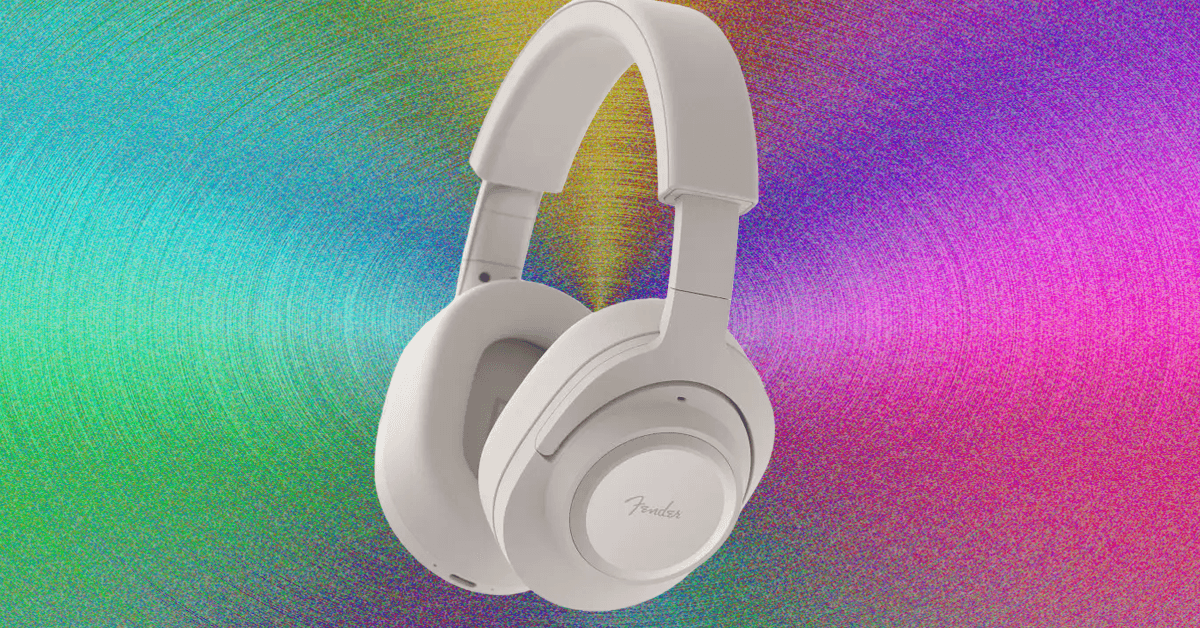
Unlike the Fairbuds XL, which can be almost completely disassembled in nine parts, the Mix are composed of four main ingredients: the headband, the ear cups, the ear cushions, and the battery. While repairability is clearly a benefit, Fender’s main focus is on the ability to mix and match the parts—hence the name. Eventually, each part will be available in five different colors, and some parts, like the ear cushions, will come in different materials for warmer or cooler climates.
My 10-day stint with the Mix wasn’t nearly enough time to evaluate whether the USB-C-based connections between the ear cups and the headband (an element they share with the Fairbuds XL) will prove sturdy enough for long-term use, but they didn’t show any obvious signs of weakness. In fact, I was impressed at how solidly the parts clicked together, and just how well built these cans feel in general. Holding them or wearing them, you’d never guess they could be pulled apart with a tug.

Photograph: Simon Cohen
I found the Mix comfy to wear, even with glasses. The ear cushions provide a soft but effective seal, and the headband does a decent job of distributing pressure. The clamping force felt a little aggressive when I first put them on, but after a few minutes, I got used to it and happily wore them for hours at a stretch. My only nitpick is the size of the ear cushion openings; they’re a little narrow for my taste. I prefer a roomier fit.
Like the Apple’s AirPods Max, the ear cushions magnetically latch to the ear cups, but on the Mix, it serves a dual purpose: Not only does it make swapping cushions a cinch, (they’ll sell for $29 a pair later this year), but it’s also how you access that USB-C Bluetooth transmitter, which lives under the left ear cushion, and how you get to the battery compartment (under the right one). Fender expects replacement cells to cost $49 but hasn’t said when they’ll be available.
Farewell Bad Transmissions

Photograph: Simon Cohen
The transmitter is a remarkably useful little tool. Using its button (and LED indicator), you can switch between lossless (red), low-latency (blue), and Bluetooth Auracast (purple) modes. Lossless (via the LHDC v5 codec in case you were curious) is a bonus, especially for iPhone owners, who are typically limited to lossy SBC and AAC connections. I don’t game, but if Fender’s claim of sub-20-millisecond performance for the low-latency mode is accurate, that should satisfy all but the most diehard, fast-action game players. Auracast (via LE Audio/LC3) is a real treat: It lets you share your audio with anyone who has an Auracast-compatible set of headphones or earbuds. The Mix can also tune into any other Auracast broadcasts, too, but there’s a catch.