

If you’ve ever wondered how many cryptocurrencies are there, the answer isn’t as simple as a single number. Thousands of new tokens are created every day, while many others disappear just as quickly.
In this guide, we provide a clear breakdown of how many cryptocurrencies exist in 2026, how many are actually active, and why the number keeps growing. We’ll also explore different types of digital currencies, key market trends, and what really matters when navigating such a crowded crypto landscape.
How Many Cryptocurrencies Are There in 2026?
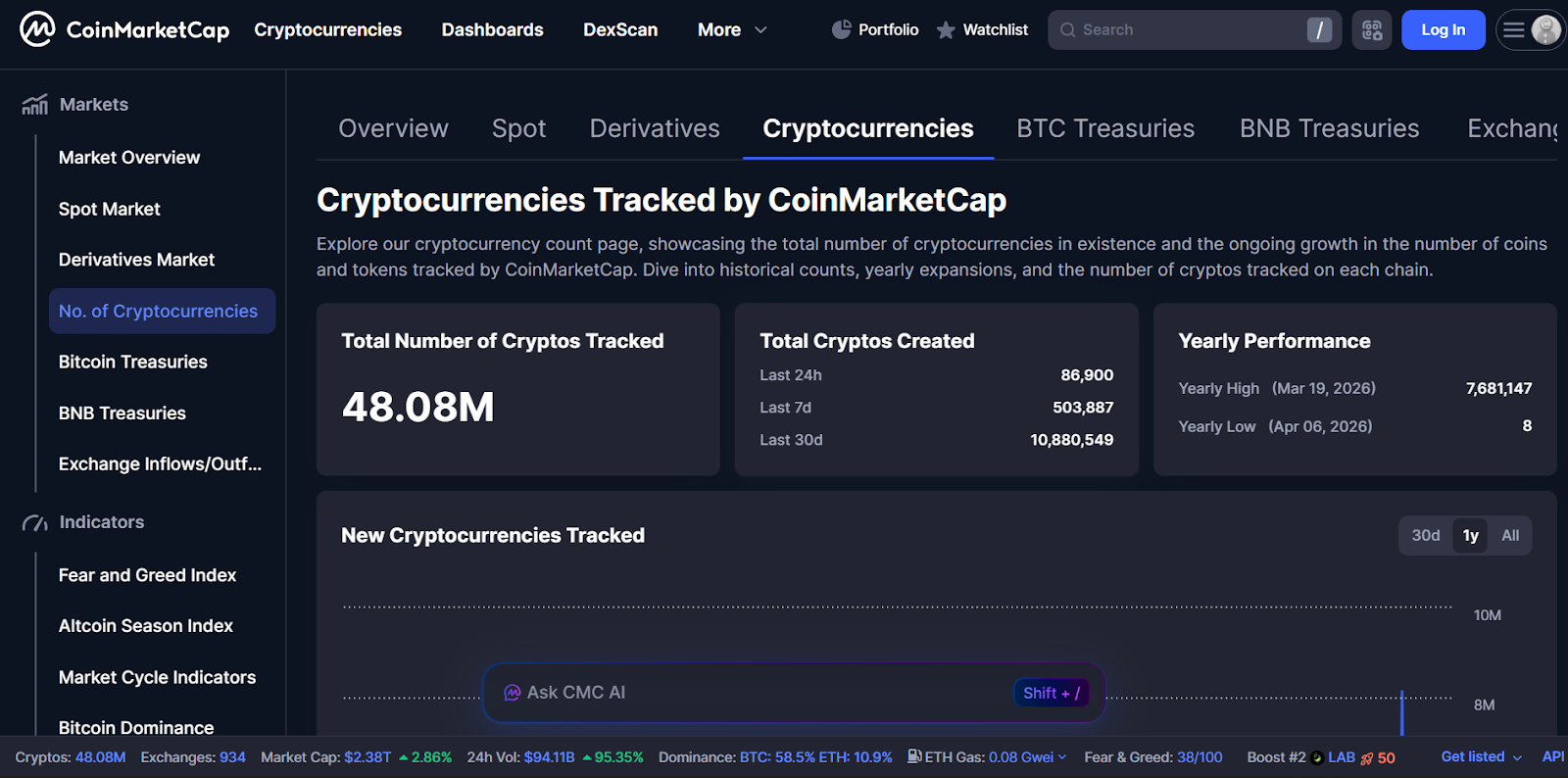
As of April 2026, there are over 50 million cryptocurrencies in existence, though only around 10,000 are actively traded. CoinMarketCap tracks approximately 8,949 active cryptocurrencies, CoinGecko lists 17,814, while Dune Analytics records over 74.5 million tokens and other digital assets created across all blockchains. However, the vast majority are inactive, low-value, or simply spam tokens with little to no real usage or trading activity.
How Many Cryptos Are Listed on Major Exchanges?
Major crypto exchanges are much more selective and only list coins they believe are safe and have real interest.
| Exchange | Cryptos Listed | Notable Coins |
| Binance | 500+ | BTC, ETH, BNB, SOL, XRP, DOGE |
| Coinbase | 275 | BTC, ETH, SOL, AVAX, ADA, USDC |
| Kraken | 650 | BTC, ETH, XRP, DOT, ADA, PI |
| KuCoin | 1,000+ | BNB, SOL, BTC, AVAX, XRP, DOT, UNI |
| Bitget | 1,300+ | SOL, XRP, ADA, LTC, BTC, BNB, PEPE |
| OKX | 300+ | BTC, ETH, SOL, TON, and derivatives |
How Has the Number of Cryptocurrencies Grown Over Time?
The growth of crypto tokens has been fast. Back in 2013, there were fewer than 100 tracked coins, with Bitcoin leading the space and only a few alternatives like Litecoin. By 2017, that number had climbed to around 1,000, marking the first major wave of expansion.
The real surge came during the 2017–2018 Initial Coin Offering (ICO) boom, when thousands of new crypto tokens launched in a short time as projects raised money from investors. Many didn’t last, and the 2018–2019 market crash wiped out a large portion of them. Then came the next wave in 2020–2021, driven by decentralized finance (DeFi) and platforms like Ethereum, pushing the total past 8,000.
From 2024 onward, growth accelerated even more as networks like Solana, Base, and BNB Chain made it incredibly cheap and easy to create tokens. At peak periods, thousands of new coins were launched daily. By early 2026, CoinGecko tracked around 17,800 cryptocurrencies, while total on-chain creations reached tens of millions.
What Are the Different Types of Cryptocurrencies?
Cryptocurrencies come in many different types, each serving a different purpose.
1. Payment Cryptocurrencies
These digital currencies are designed primarily to send and receive value, functioning like digital cash. Bitcoin (BTC) remains the most valuable and widely held, with a market cap of approximately $1.4 trillion.
Litecoin (LTC), Bitcoin Cash (BCH), and XRP are other successful cryptocurrencies in the payment sector. XRP, developed by Ripple, focuses specifically on cross-border institutional payments and has seen significant adoption by major banks in recent years.
2. Smart Contract Platforms
Smart contract platforms allow developers to build and run applications directly on the blockchain, going beyond simple money transfers. Instead of just sending funds, users can interact with apps for trading, lending, gaming, and NFTs without relying on traditional middlemen.
Ethereum remains the dominant platform, supporting much of the DeFi and NFT ecosystem. Other networks like Solana, BNB Chain, Avalanche, Cardano, and Polkadot compete by offering faster speeds or lower costs. Each uses its own token for transactions, and as more apps launch, new tokens continue to enter the market.
3. Stablecoins

Stablecoins are cryptocurrencies designed to keep a steady value, usually tied to the US dollar. They give users a way to hold digital dollars on the blockchain without moving money back into traditional banks.
Tether (USDT) is the largest stablecoin, with a market cap above $142 billion, making it one of the biggest cryptocurrencies overall. USD Coin (USDC) follows with around $58 billion and is backed by regulated reserves. Stablecoins are widely used for trading and payments.
4. Meme Coins

Meme coins are cryptocurrencies built around internet jokes, trends, or popular culture rather than real utility. They often gain attention through hype and community support instead of offering a clear use case.
Dogecoin was the first major meme coin, created in 2013 as a joke based on a Shiba Inu meme. It was followed by others like Shiba Inu, PEPE, and BONK. Many of these tokens rise and fall quickly, especially on fast networks like Solana, where new coins launch daily. While most end up worthless, a few manage to build strong communities and maintain significant market value.
5. DeFi Tokens

Decentralized finance tokens are linked to platforms that offer financial services without traditional middlemen like banks or brokers. These platforms run on blockchains and allow users to trade, lend, borrow, and earn interest directly through automated systems.
Examples include UNI from Uniswap for trading, AAVE for lending and borrowing, MKR for managing the DAI stablecoin system, and COMP from Compound. These tokens are often used for voting on how the platform operates and can also provide rewards.
6. Privacy Coins & Other Categories

Privacy coins focus on keeping transactions hidden by masking details like the sender, receiver, and amount. Monero (XMR) is the most widely used, known for strong privacy features, while Zcash (ZEC) offers optional privacy settings. However, regulatory pressure has led to some of these coins being removed from major exchanges.
Beyond privacy coins, several other categories are shaping the market:
- Gaming and NFT tokens used within digital ecosystems
- Real-world asset tokens representing ownership of assets like Treasury bills or real estate on-chain
- Oracle tokens, such as Chainlink, that bring real-world data onto blockchains
- Infrastructure tokens like Filecoin that support services such as decentralized storage
Why Are There So Many Cryptocurrencies?
There are several reasons for the so many different cryptocurrencies:
Low Barrier to Entry and Ease of Creation
Creating new digital tokens is surprisingly simple and inexpensive. On networks like Ethereum, anyone can launch a basic token for just a small transaction fee, often only a few dollars.
On faster and cheaper blockchains like Solana and BNB Chain, the cost for creating digital assets is even lower. Tools such as Pump.fun on Solana make it possible to create a meme coin in minutes without any coding experience. Because of this, whenever something trends online, people can quickly turn it into a token, even though most of these coins never gain real value and end up failing.
The Role of Solana, Base & BNB Chain
A large share of new tokens comes from a few major blockchain networks. Solana became especially popular in 2024 and 2025 thanks to its fast transactions and very low fees, making it ideal for launching meme coins.
Base, Coinbase’s Layer-2 network on Ethereum, became a major hub for new token deployments in 2025 as user adoption grew rapidly. BNB Chain (formerly Binance Smart Chain) has hosted thousands of tokens since 2020 and remains a major venue for lower-cost DeFi projects.
Speculation, Meme Coins & Rug Pulls
Many new cryptocurrencies are created mainly for speculation rather than long-term use. In some cases, developers launch a token, build hype around it, and then sell their holdings quickly, causing the price to crash. This type of exit scam is often referred to as a rug pull.
These projects contribute heavily to the millions of tokens that exist, but have little to no real activity or purpose. As a result, only a small fraction of cryptocurrencies end up being actively traded, while the majority fade away shortly after launch.
Which Cryptocurrencies Actually Matter?
Out of the millions that exist, only a small number really matter. The top 10 or 20 coins make up the vast majority of the total market value. Bitcoin and Ethereum alone dominate because they have the most users, security, and real-world use. Others include:
- BNB: Used within the BNB Chain ecosystem to power transactions, DeFi, and token launches.
- Solana: Known for high-speed transactions and low fees. It’s popular for DeFi, NFTs, and meme coins.
- XRP: Widely used by financial institutions for fast and low-cost cross-border payments.
- Cardano: Emphasizes a research-driven approach and peer-reviewed development.
- Polkadot: Enables interoperability between different blockchains.
When choosing which ones to pay attention to, most people look at market size, daily trading volume, and actual usefulness rather than just the total count.
Key Cryptocurrency Market Statistics in 2026
To understand how large the crypto space has become, it helps to look at the numbers behind its growth and global adoption.
Global Crypto Market Cap & Users
The global cryptocurrency market capitalization stands at approximately $2.47 trillion as of early April 2026, according to CoinGecko. This is down from a peak of approximately $4 trillion in late 2024 but remains dramatically higher than where the market stood in prior cycles.
Crypto adoption is also growing quickly. Approximately 560 million people globally own at least one cryptocurrency as of 2026, representing approximately 9.9% of the world’s connected population. The global user base is expected to approach one billion by 2027 at current growth rates, per Statista and Opalesque projections.
Crypto Ownership by Country
Crypto ownership varies widely across countries, and the highest adoption rates tend to come from places with strong internet access, younger populations, and supportive regulations. Countries with the highest crypto ownership include:
- The United Arab Emirates tops the list with 30.4% of its population owning cryptocurrency ( approximately 3 million people). The government’s progressive stance on blockchain technology regulation, the establishment of crypto-friendly free zones like the DMCC and ADGM, and the country’s drive to diversify beyond oil have made the UAE the world’s leading crypto nation by adoption rate.
- Vietnam ranks second with 21.2% of its population engaged in cryptocurrency, equating to around 21 million people. The country’s youthful demographic and high rates of mobile and internet usage are the primary drivers.
- The U.S. has the highest number of crypto owners, with 15.6% of its population owning crypto (53 million). Strong infrastructure, high income levels, and growing institutional involvement have helped drive adoption.
- Singapore also ranks among the top adopters globally, supported by its highly educated, tech-savvy population, a strong presence of blockchain startups, and its position as a leading global financial centre.
Across these countries, adoption is largely driven by practical needs such as easier payments, access to financial services, and protecting wealth.
Crypto Ownership by Demographics
Crypto ownership in 2026 still leans toward younger users, especially men, though the gap is slowly narrowing. The 25–34 age group has the highest participation, with more men investing than women across all age ranges. Overall, men make up about 61% of global crypto owners.
By generation, Millennials lead the way, accounting for around 57% of crypto owners in the U.S., followed by Gen X at 20% and Gen Z at 13%. However, Gen Z is growing the fastest, with about 28% of young adults already owning crypto.
Conclusion
Despite there being over 50 million cryptocurrencies, only a small fraction are meaningfully active. CoinGecko curates around 17,800, CoinMarketCap shows roughly 8,500 active listings, while Dune Analytics tracks about 900,000 tokens with on-chain activity. The high number of cryptocurrencies arise from the extremely low barriers to token creation on chains such as Solana, Base, and Ethereum, where anyone can launch a new token in minutes. However, most become obsolete quickly due to a lack of liquidity, community support, or token utility, resulting in massive attrition.
FAQs
There are about 17,000+ cryptocurrencies that are actively traded today. These are the ones with real market activity, liquidity, and consistent buying and selling. The rest may exist on-chain but have little to no actual usage.
Over 53% of tokens launched since 2021 have failed, with around 86% of those failures happening in 2025 alone. This shows how risky and short-lived many projects can be.
Coinbase lists about 275 cryptocurrencies on its platform, focusing on projects that meet strict standards for security, compliance, and demand. This includes major assets like Bitcoin, Ethereum, Solana, and Cardano. Because of this approach, Coinbase offers a more curated selection of the most successful cryptocurrencies compared to exchanges that list hundreds of newer or less-established tokens.
Binance offers more than 500 cryptocurrencies and over 1,500 trading pairs, giving users access to both major and emerging assets. Popular pairs include Bitcoin/USDT, Ethereum/USDT, BNB/USDT, and Solana/USDT. This wide selection makes Binance one of the most diverse platforms for trading different cryptocurrencies.
CoinMarketCap tracks over 48 million cryptocurrencies across more than 900 exchanges. However, only a small portion of these are actively traded or widely used in the market.
To judge if a cryptocurrency is legitimate, look at its use case, team transparency, and trading activity. Strong projects usually have active development, clear goals, and consistent volume, while risky ones often rely on hype with little real substance.