

Key Takeaways:
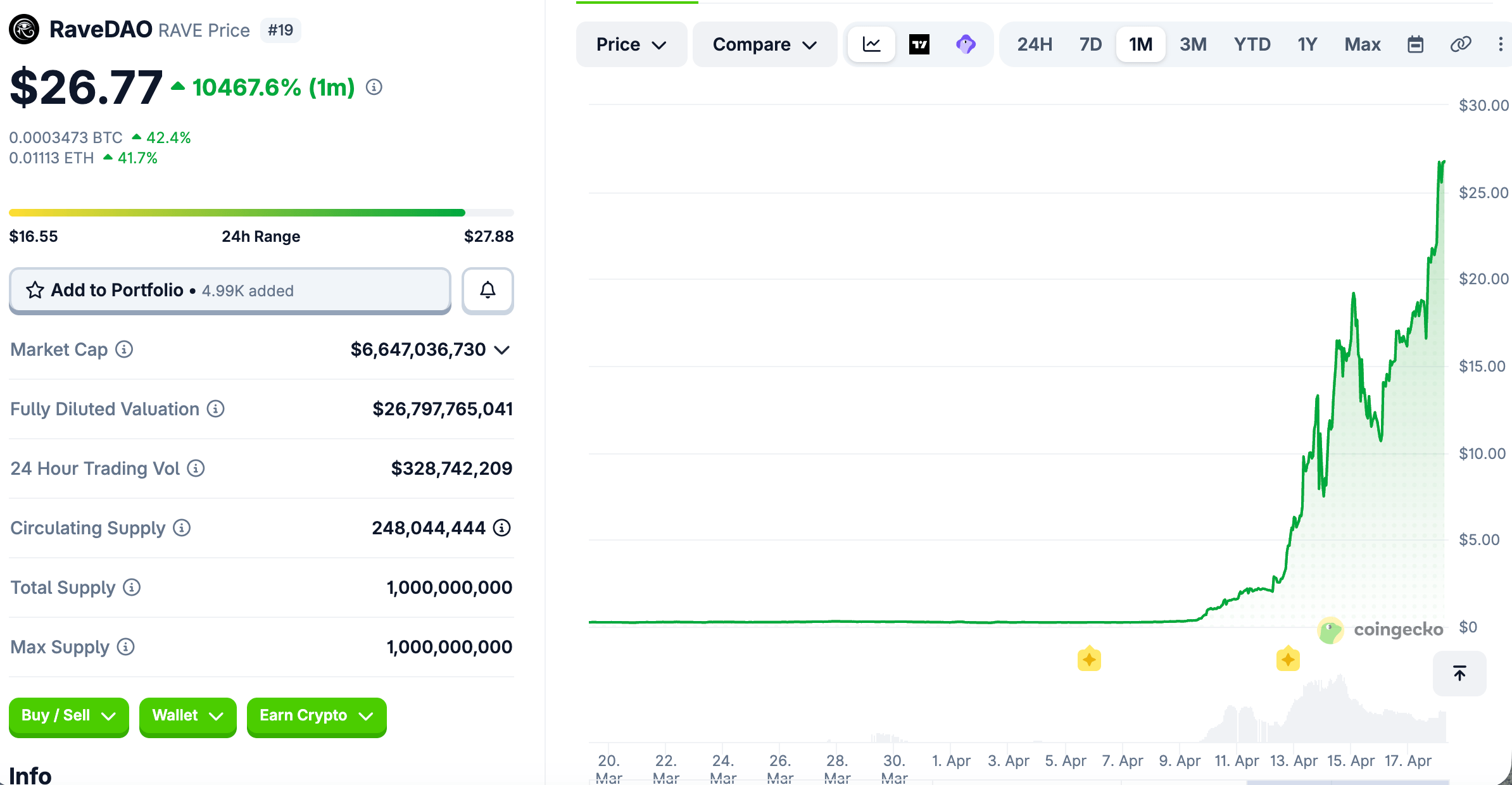
- RaveDAO’s RAVE token soared 10,000% since April 1, hitting a record $27.88 and a $6.6 billion market cap.
- Extreme volatility on Binance and Bitget wiped out 16,000 traders in a massive $19 million short squeeze.
- Concerns loom over RAVE’s future as critics warn of a “pump and dump” with insiders holding 90% of supply.
Liquidation Chaos and the Short Squeeze Phenomenon
The Web3 music protocol RaveDAO’s utility token continued its surge Saturday, jumping by nearly 50% in 24 hours to register a new all-time high of $27.88. As of 1:23 a.m. EDT on April 18, RAVE’s latest spike brought its weekly gains to more than 1,200% and more than 10,000% since April 1.
Although the price later retreated to just under $27, the jump saw RAVE’s market capitalization rise to approximately $6.6 billion. In just a week, RAVE has moved from a micro-cap token to one of the 20 high-cap tokens tracked by Coingecko. Now ranked No. 19, RAVE has overtaken well-known tokens such as XMR, XLM, and ZEC, and appeared poised to glide past LINK at the time of writing.
Rave’s price action also triggered just over $19 million in leveraged position liquidations, wiping out nearly 16,000 traders within 24 hours. Liquidated shorts accounted for nearly $17 million of those positions; the single largest liquidation during the period was $161,505.
However, Rave’s astronomical rise continues to be dogged by controversy, particularly regarding the token’s distribution. With only 248 million tokens out of a maximum supply of 1 billion in circulation, some critics warn that the distribution structure points to future stability problems. At current prices, tokens not in circulation are valued at $19.44 billion, a nearly 100-fold increase from just over $195 million on April 1.
In an April 13 post on X, Jeremy, an angel investor, raised similar concerns and drew attention to unusual token movements hours before RAVE’s parabolic run.
“Roughly 10 hours before the price exploded, wallets linked to the RaveDAO deployer quietly moved 18.58 million tokens to Bitget,” he wrote. “No announcement. No disclosure. Price is still under $0.50. Ten hours later, the price started moving, and it didn’t stop.”
Centralization Red Flags
The investor further noted that open interest in RAVE futures ballooned past $200 million, a massive surge accompanied by a relative strength index ( RSI) that pierced the 95 level—signaling an extremely overextended market. On the other hand, daily trading volume hit $270 million, effectively matching the project’s entire market capitalization at the time. This volatility proved catastrophic for bears; despite 74% of Binance traders being positioned for a decline, a brutal short squeeze forced $17 million in liquidations in a single 24-hour window.
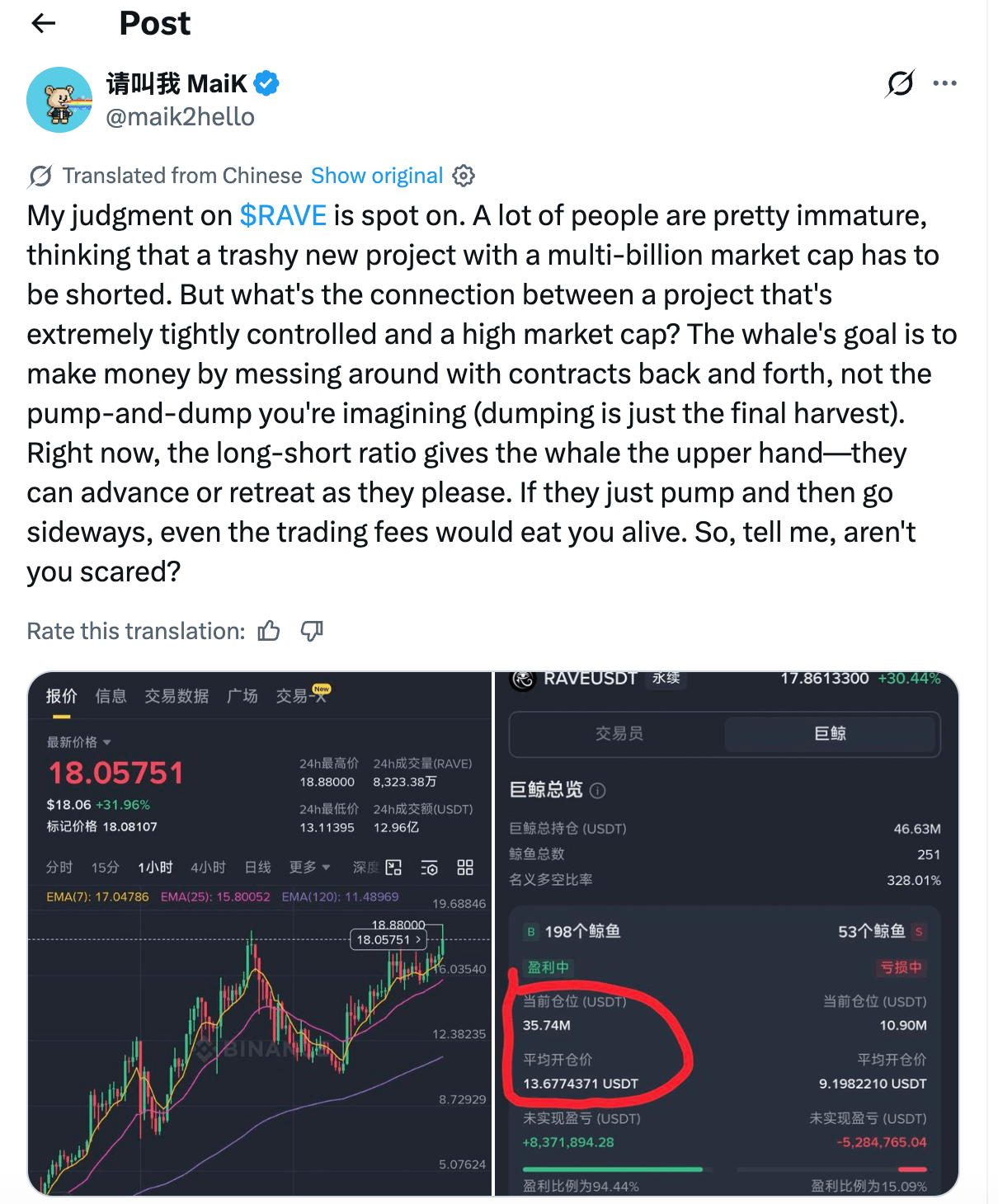
Jeremy contends that this vertical price action was far from a “retail-driven discovery” of a hidden gem. Rather, he characterizes it as a calculated short squeeze engineered on a low-float asset. With the core team controlling a staggering 90% of the total supply, Jeremy suggests the rally served as a manufactured liquidity event, allowing insiders to stage a massive exit on centralized exchanges.
In the wake of Jeremy’s post, RAVE’s valuation has more than doubled, intensifying the outcry of pump and dump allegations. This vertical ascent has sparked a wave of skepticism across social media, with observers drawing parallels to previous moon shots like ARIA and SIREN.
Those projects, which similarly posted astronomical gains over a short horizon, eventually suffered catastrophic collapses—leaving retail investors holding the bag as liquidity evaporated.