
Key Takeaways:
- RAVE crashed sharply, confirming a rapid and disorderly market unwind.
- Binance data shows a 68% peak-to-trough drop, exposing severe volatility.
- Bitget and Binance launched investigations, signaling deeper scrutiny ahead.
RAVE Collapse Fuels Exchange Manipulation Fears
A sharp collapse in the RAVE token is reinforcing systemic concerns around exchange-level surveillance, as manipulation and pump-and-dump dynamics resurface in thin liquidity environments. On April 18, RAVE plunged more than 60% from its high as Binance and Bitget began reviewing the claims. The selloff unfolded rapidly, with price action confirming a disorderly unwind across major trading venues.
Allegations of coordinated trading behavior across multiple exchanges have intensified scrutiny around the token’s recent activity. ZachXBT asserted on social media platform X:
“Pump and dump activity for $RAVE originated on @Bitget @Binance @Gate.”
The on-chain investigator called on exchange leadership to strengthen internal controls, initiate formal probes, and remove any actors linked to the activity. He initially offered a $10,000 incentive, later increasing the bounty to $25,000 following additional community contributions, to encourage whistleblowers to submit evidence privately. The allegations also highlighted that insiders controlled more than 90% of RAVE support, raising concerns over price influence and retail exposure. ZachXBT stressed: “We cannot allow this blatant market manipulation by insiders controlling >90% RAVE support to further extract from retail investors.”
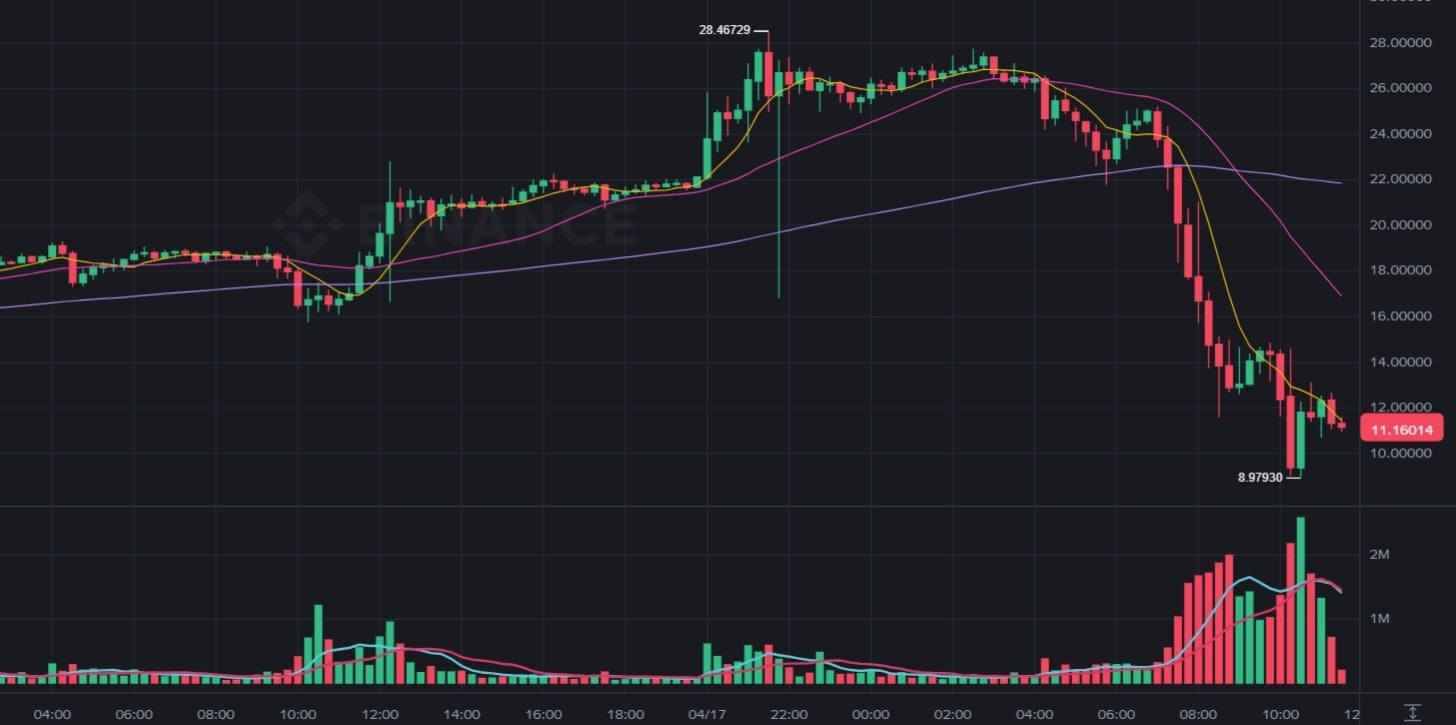
Market data across multiple platforms highlights the scale of the decline. Data from Binance indicates a rejection from roughly $28.47 to a low near $8.98, translating to an approximate 68% peak-to-trough drop. Coingecko data shows a similar move, with RAVE falling from $27.88 to $9.46, representing an approximate 66% decline. Tradingview data reflects a comparable pattern, with the token dropping from $27.80 to $9.48, marking a roughly 66% decrease. Kraken data also shows a comparable fall from $28.58 to $9, equating to an approximate 68.5% decline. These aligned readings reinforce the severity and consistency of the selloff across major platforms.
Supply Concentration and Liquidation Risks Draw Scrutiny
Responding to the claims, both Bitget and Binance indicated they would review the situation. Bitget Chief Executive Officer Gracy Chen replied to ZachXBT: “Thanks for highlighting! We’ve started investigating into $RAVE.” Binance Chief Executive Officer Richard Teng responded: “Thanks for flagging this with us ZachXBT.” Teng continued:
“We’re looking into it. We will always do our part to investigate all market misconduct.”
Order flow and volume behavior support the manipulation thesis. Sell-side pressure accelerated alongside sharp volume spikes during the decline, consistent with coordinated distribution. The prior uptrend showed controlled accumulation followed by a vertical expansion phase, a pattern frequently observed in engineered squeezes. Once momentum reversed, short-term moving averages broke below longer-term signals, confirming trend failure. The concentration of more than 90% of supply among insiders materially increases liquidation risk when coordinated exits are triggered, particularly in low float conditions.
Additional scrutiny focuses on the mechanics behind the earlier rally and subsequent unwind. RaveDAO warned on April 14 on X: “We have observed heightened market volatility in $RAVE. We encourage all users to remain mindful of the associated risks and to exercise caution, particularly when using leveraged positions.” The token, tied to a Web3 music and entertainment protocol, has recorded more than a 10,000% rise since April 1, drawing skepticism from analysts. Critics pointed to a $42 million token transfer to Bitget ahead of the move, followed by liquidity withdrawal that forced short covering and drove price acceleration. The sequence triggered more than $37 million in liquidations within 24 hours on April 13. Analysts also flagged extreme supply concentration, with only 248 million of the 1 billion total tokens in circulation, a structure that can amplify price swings and enable outsized influence from a small group of holders.