
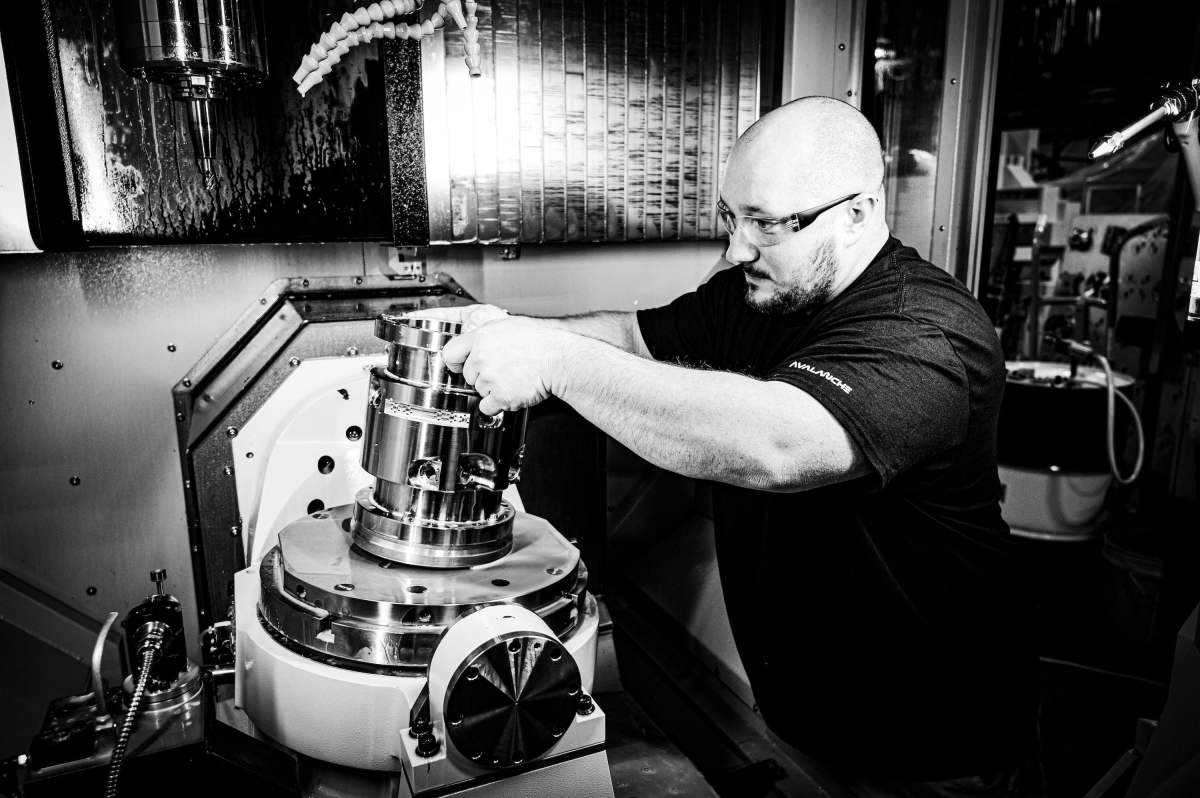
Nuclear fusion conjures images of massive reactors or banks of dozens of large lasers. Avalanche co-founder and CEO Robin Langtry thinks smaller is better.
For the last several years, Langtry and his colleagues at Avalanche have been working on what’s essentially a desktop version of nuclear fusion. “We’re using the small size to learn quickly and iterate quickly,” Langtry told TechCrunch.
Fusion power promises to supply the world with large amounts of clean heat and electricity, if researchers and engineers can solve some vexing challenges. At its core, fusion power seeks to harness the power of the Sun. To do that, fusion startups must figure out how to heat and compress plasma for long enough that atoms inside the mix fuse, releasing energy in the process.
Fusion is a famously unforgiving industry. The physics is challenging, the materials science is cutting edge, and the power requirements can be gargantuan. Parts need to be machined with precision, and the scale is usually so large as to obviate rapid fire experimentation.
Some companies like Commonwealth Fusion Systems (CFS) are using large magnets to contain the plasma in a doughnut-like tokamak, others are compressing fuel pellets by shooting them with powerful lasers. Avalanche, though, uses electric current at extremely high voltages to draw plasma particles into an orbit around an electrode. (It also uses some magnets to keep things orderly, though they’re not nearly as powerful as a tokamak’s.) As the orbit tightens and the plasmas speed up, the particles begin to smash into each other and fuse.
The approach has won over some investors. Avalanche recently added another $29 million in an investment round led by R.A. Capital Management with participation from 8090 Ventures, Congruent Ventures, Founders Fund, Lowercarbon Capital, Overlay Capital, and Toyota Ventures. To date, the company has raised $80 million from investors, a relatively small amount in the fusion world. Other companies have raised several hundred to a few billion dollars.
Space-based inspiration
Langtry’s time at the Jeff Bezos-backed space tech company Blue Origin influenced how Avalanche is tackling the problem.
Techcrunch event
Boston, MA
|
June 23, 2026
“We’ve figured out that using this sort of SpaceX ‘new space’ approach is that you can iterate really quickly, you can learn really quickly, and you can solve some of these challenges.” said Langtry, who worked with co-founder Brian Riordan at Blue Origin.
Going smaller allowed Avalanche to speed up. The company has been testing changes to its devices “sometimes twice a week,” something that would be challenging and costly with a large device.
Currently, Avalanche’s reactor is only nine centimeters in diameter, though Langtry said a new version grow to 25 centimeters and is expected to produce about 1 megawatt. That, he said, “is going to give us a significant bump in confinement time, and that’s how we’re actually going to get plasmas that have a chance of being Q>1.” (In fusion, Q refers to the ratio of power in to power out. When it’s greater than one, the fusion device is said to be past the breakeven point.)
Those experiments will be carried out at Avalanche’s FusionWERX, a commercial testing facility the company also rents out to competitors. By 2027, the site will be licensed to handle tritium, an isotope of hydrogen that’s used as fuel and is crucial to many fusion startup’s plans for producing power for the grid.
Langtry wouldn’t commit to a date when he hopes Avalanche will be able to generate more power than its fusion devices consume, a key milestone in the industry. But he’s thinks the company is on a similar timeline as competitors like CFS and the Sam Altman-backed Helion. “I think there’s going to be a lot of really exciting things happening in fusion in 2027 to 2029,” he said.