

Are you looking for the best crypto portfolio tracker to manage your digital assets without stress? When you find the right crypto portfolio tracker, your entire investing experience changes. You stop guessing, hopping between apps, and finally see your holdings, gains, and losses in one clear view. That means better decisions, less time wasted, and more confidence every time the market moves.
In this article, we walk you through the top crypto portfolio trackers for 2026, compare leading tools, break down key features, pricing, tax support, and explain what actually matters when choosing one. Whether you trade daily, hold long term, or manage DeFi and NFTs, this guide helps you find a tracker that fits your style and goals. Read on to see which tools stand out and why.
Top 10 Crypto Portfolio Tracker Compared
| Crypto Tracker App | Price | Supported Platforms | Best For | Trustpilot Scores |
| CoinLedger | Prices range from $49-199 | Web, Mobile | Tax reporting and portfolio tracking | 4.8/5 |
| CoinStats | Free / $13.99 per month | Web, iOS, Android | All-in-one asset management | 4.7/5 |
| CoinTracker | Free / Tiered Plans,starter
$49-239 |
Web, Mobile | Tax and performance tracking | 3.5/5 |
| Delta | Free / $59.99 annually | iOS, Android | Multi-asset tracking | 4.6/5 |
| Koinly | from $49 to $179 | Web | Tax reports and wallet tracking | 4.8/5 |
| CoinMarketCap | Free, starter $29, Startup, $79, Standard $299 | Web, Mobile | Manual entry and price alerts | 4.3/5 |
| ZenLedger | Silver $49/year, Gold plan $199/year
Platinum $399/year |
Web | DeFi and tax tracking | 4.6/5 |
| TokenTax | Basic-$65/tax year
Premium $199/tax year Pro $1,999/tax year VIP $3,499/tax year |
Web | Professional crypto accounting | 4.6/5 |
| Kubera | Try for free for 14 days | Web | Net worth tracking | 4.1/5 |
| Summ | Free / Paid plans from $49 to $299 per tax yearFree / Paid plans from $49 to $299 per tax year | Web | Accurate global crypto tax reporting and DeFi transactions | 4.7/5 |
Best Crypto Portfolio Trackers in 2026
Before you start managing your digital assets effectively, choose the right tools. The best crypto portfolio trackers in 2026 offer integration, advanced features, and robust security to help you stay on top of your investments. Here are the top options to consider.
1. CoinLedger: Best for Tax Reporting and Portfolio Tracking
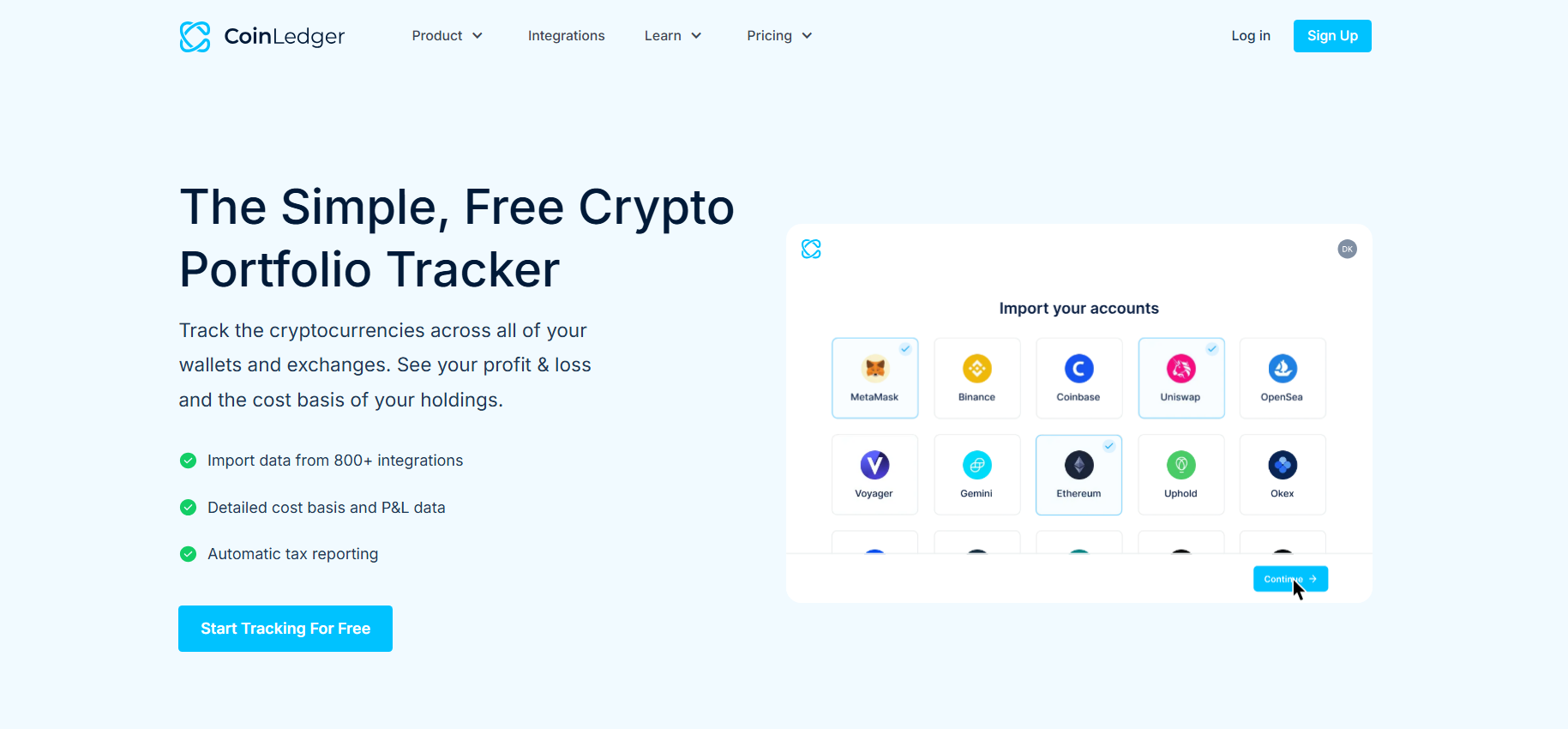
CoinLedger stands out as one of the best crypto wallet trackers with over 500,000 investors worldwide. We like it because it keeps portfolio tracking and tax reporting in one simple place. You can connect exchanges, wallets, and blockchains in minutes and get a clear view of your digital assets without manual work. It works well whether you’re just getting started or already managing a large crypto portfolio.
Key Features
- Exchange and blockchain integrations that sync transactions automatically
- User-friendly interface that’s easy to navigate and understand
- Automatic crypto tax calculations to save time during tax season
- Tax loss harvesting insights to help reduce your overall tax bill
Pricing
- Free to use for portfolio tracking
- Paid plans range from $49 to $199 based on transaction volume and features
Pros and Cons
| Pros | Cons |
| Supports a wide range of exchanges and wallets | Tax reports require a paid plan |
| Makes crypto tax reporting faster and easier | Limited support for very complex DeFi transactions |
| Simple design that works for beginners and experienced investors |
2. CoinStats: Best for All-In-One Asset Management
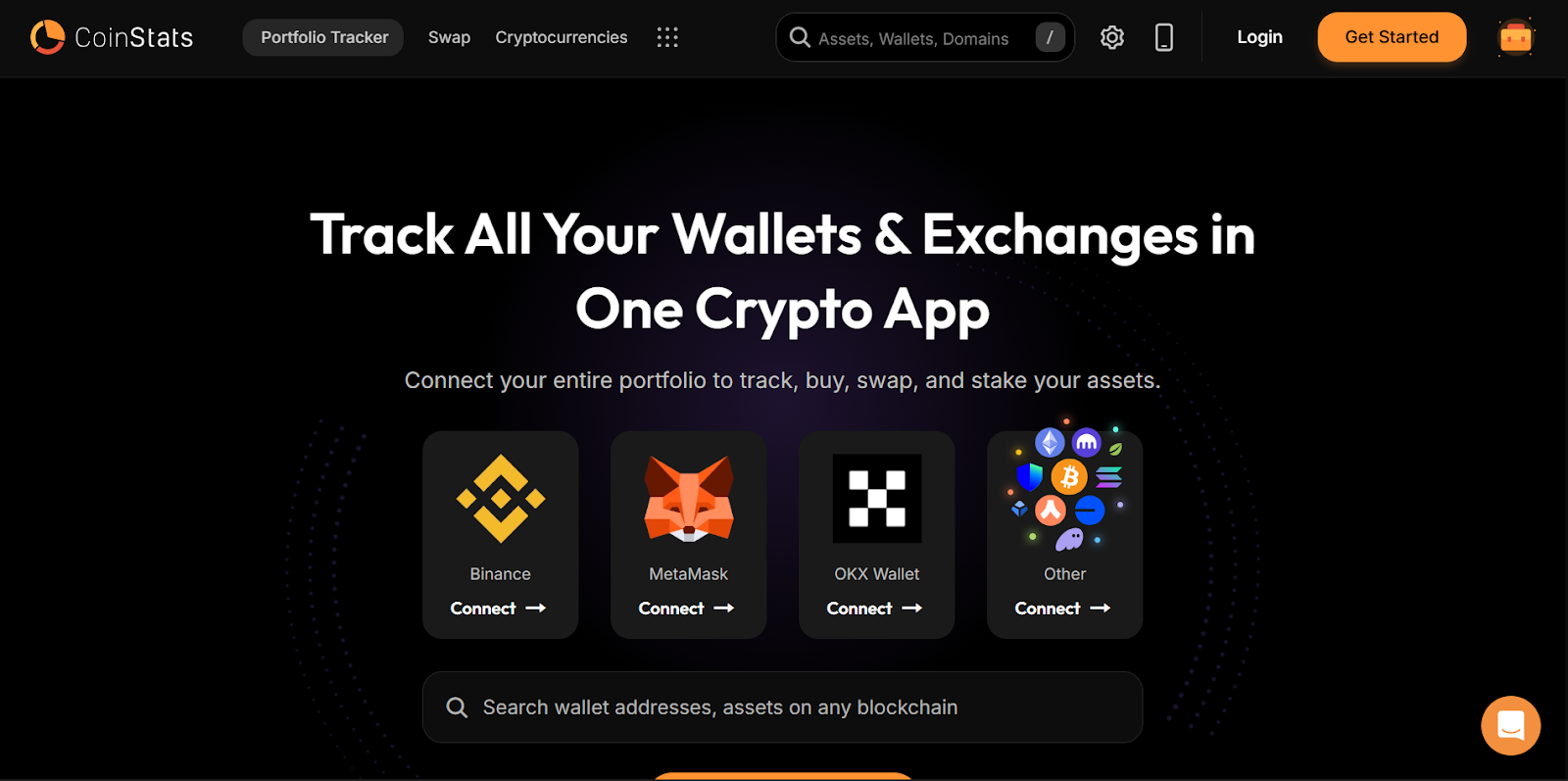
CoinStats helps you track assets through a single, centralized dashboard. Portfolio data stays organized across exchanges, wallets, and DeFi platforms. Built-in wallet functionality allows buying, swapping, and earning yield directly inside the app. All-in-one design makes it suitable for active and long-term investors.
Key Features
- Track up to 1,000 transactions for free
- Built-in wallet for buying, swapping, and earning
- Tax reporting via CoinLedger integration
Pricing
- Free for basic tracking
- Paid plans start at $13.99 per month
Pros and Cons
| Pros | Cons |
| Combines tracking and wallet tools | Advanced tools require payment |
| Supports DeFi and NFTs | Limited deep analytics |
| Easy to use for all experience levels |
3. CoinTracker-Best for Tax and Performance Tracking
CoinTracker focuses on automated portfolio tracking and crypto tax reporting. Exchange and wallet connections eliminate manual transaction entry. Real-time updates keep portfolio performance visible at all times. Tax calculations help simplify capital gains reporting.
Key Features
- Syncs with 300+ exchanges and wallets
- Real-time portfolio performance updates
- Built-in tax calculations
Pricing
- Free for basic use
- Paid plans range from $49 to $239
Pros and Cons
| Pros | Cons |
| Strong automation and integrations | Premium pricing for advanced use |
| Beginner-friendly interface | Occasional cost basis issues |
| Scales well for high-volume traders |
4. Delta: Best for Multi-Asset Tracking

Delta offers a unified way to track crypto, stocks, and NFTs together. Mobile-first design makes portfolio monitoring simple on the go. Trade insights help support better investment decisions. Multi-asset support works well for diversified portfolios.
Key Features
- Tracks crypto, stocks, and NFTs
- Trade insights and performance analytics
- Real-time alerts
Pricing
- Free version available
- Pro plan costs $59.99 per year
Pros and Cons
| Pros | Cons |
| Strong multi-asset tracking | Limited DeFi coverage |
| Clean and intuitive interface | Pro plan required for full access |
| Useful analytics for traders |
5. Koinly: Best for Tax Reports and Wallet Tracking
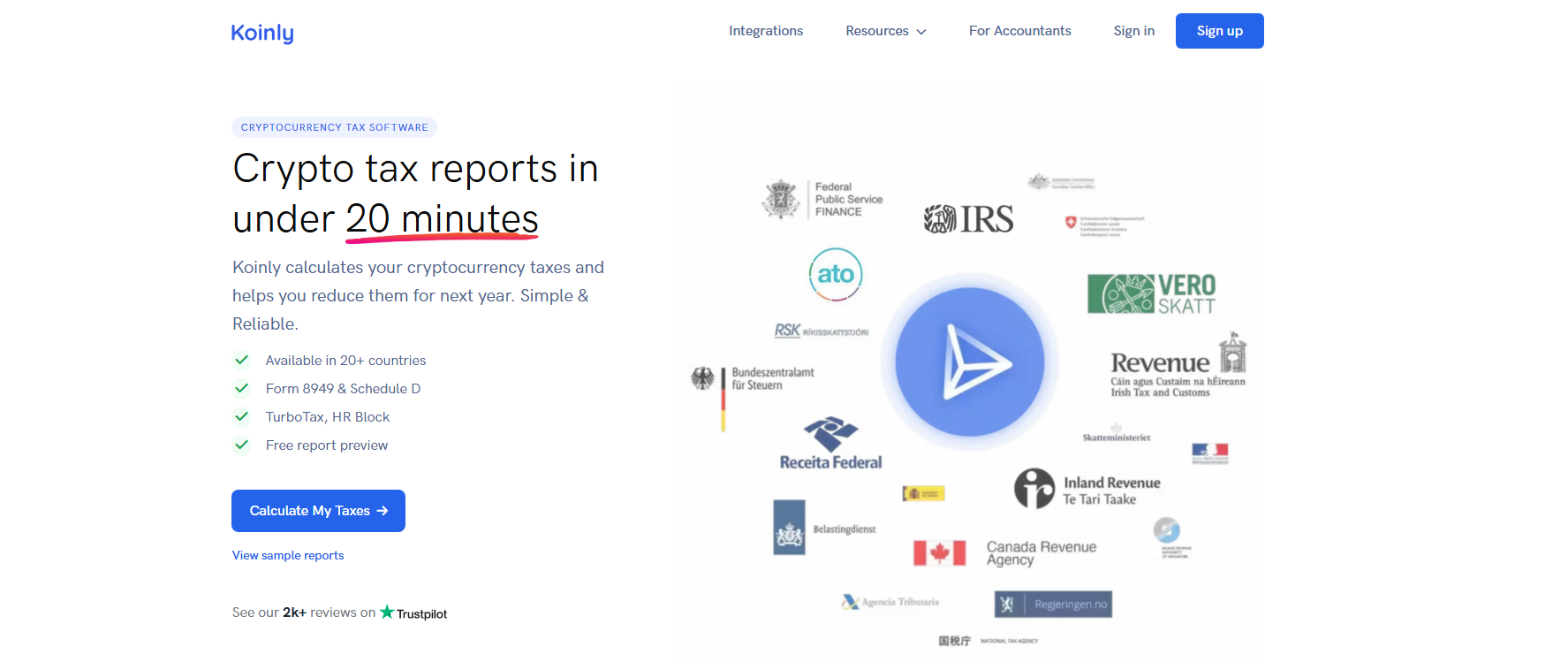
Koinly combines portfolio tracking with advanced crypto tax reporting. Broad wallet and exchange support makes it suitable for complex portfolios. Automated calculations reduce errors during tax season. Security-focused design reassures users asking if crypto portfolio trackers safe. Koinly is a top choice for tax reporting and portfolio tracking, known for its robust integrations and ease of use.
Key Features
- Supports 700+ exchanges and wallets
- Automated capital gains calculations
- Detailed tax reports
Pricing
- Free for tracking
- Paid plans range from $49 to $179
Pros and Cons
| Pros | Cons |
| Excellent tax accuracy | Tax reports require payment |
| Wide integration coverage | Limited advanced DeFi handling |
| Easy-to-follow reports |
6. CoinMarketCap: Best for Manual Entry and Price Alerts
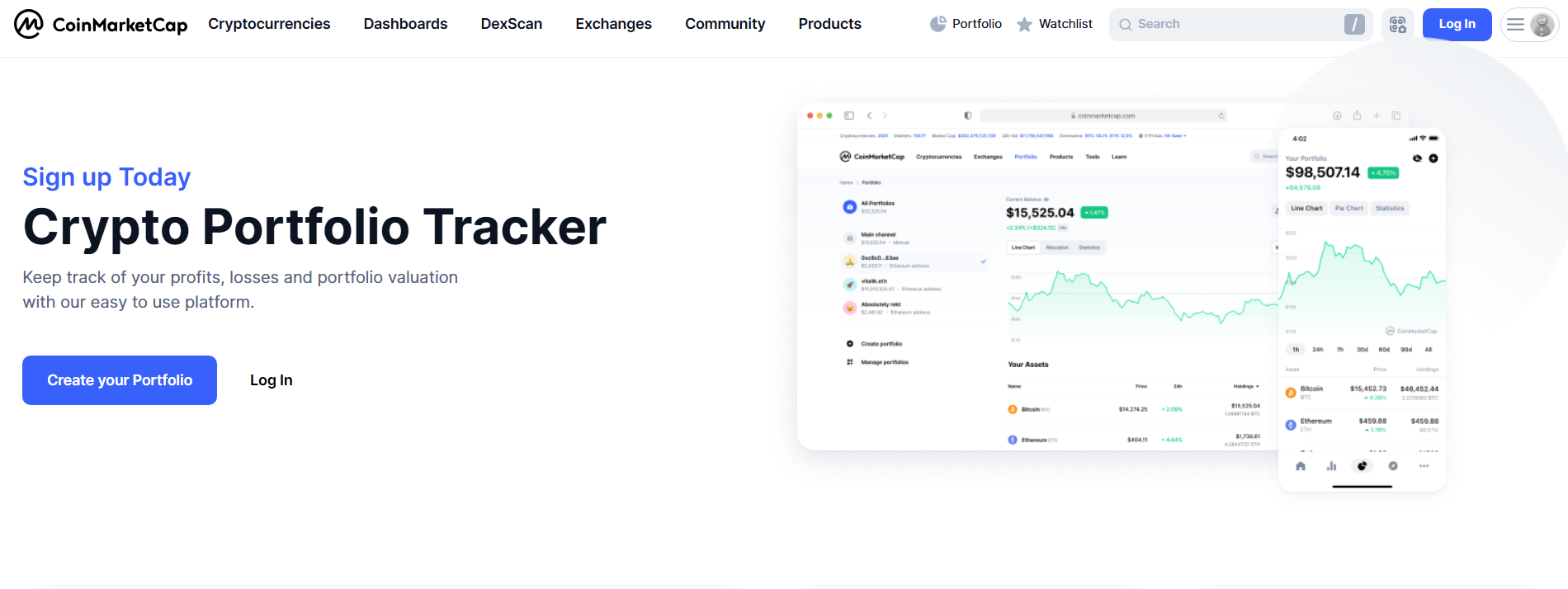
CoinMarketCap provides simple portfolio tracking backed by trusted market data. Manual tracking works well for beginners or casual investors. Market insights pair well with using a best crypto trading bot. Free access makes it an easy starting point. It is a simple portfolio tracker for those using the best crypto trading bot or manually managing their investments.
Key Features
- Manual entry or API tracking
- Price alerts and market updates
- Mobile app support
Pricing
- Free plan available
- Starter $29, Startup $79, Standard $299
Pros and Cons
| Pros | Cons |
| Beginner-friendly | Limited advanced tools |
| Trusted crypto data source | Manual updates required |
| No cost to start |
7. ZenLedger: Best for DeFi and Tax Tracking
ZenLedger serves investors focused on taxes and complex portfolios. DeFi and blockchain support extends beyond basic tracking. Accounting-style reporting delivers deeper financial visibility. Portfolio tracker features pair well with tax compliance needs.
Key Features
- DeFi and blockchain support
- Detailed tax and portfolio reports
- Unified accounting view
Pricing
- Silver $49 per year
- Gold $199 per year
- Platinum $399 per year
Pros and Cons
| Pros | Cons |
| Strong tax and DeFi coverage | Steeper learning curve |
| Advanced reporting tools | Higher pricing tiers |
| High security standards |
8. TokenTax: Best for Professional Crypto Accounting
TokenTax targets investors with complex tax requirements. Software tools combine with access to licensed CPAs. High-touch services help reconcile intricate transaction histories. Premium positioning fits advanced portfolios.
Key Features
- Exchange and wallet tracking
- CPA-assisted reconciliation
- Institutional-grade tax reports
Pricing
- Basic $65 per tax year
- Premium $199 per tax year
- Pro $1,999 per tax year
- VIP $3,499 per tax year
Pros and Cons
| Pros | Cons |
| Professional tax support | Expensive plans |
| Handles complex portfolios | Not ideal for casual users |
| High reporting accuracy |
9. Kubera: Best for Net Worth Tracking

Kubera tracks crypto alongside traditional assets in one dashboard. Net worth visibility extends beyond crypto-only tools. Clean interface focuses on privacy and clarity. Long-term investors benefit most from its design.
Key Features
- Tracks crypto, stocks, and real estate
- Manual and automatic syncing
- Net worth insights
Pricing
- 14-day free trial
- $150 per year
Pros and Cons
| Pros | Cons |
| Excellent for total net worth tracking | No free plan |
| Clean and simple interface | Limited crypto-specific tools |
| Strong privacy focus |
10. Summ: Best for Accurate Global Crypto Tax Reporting and DeFi Transactions
Summ, formerly known as CryptoTaxCalculator, is a specialized crypto portfolio and tax tracking tool designed for investors who want highly accurate tax calculations across multiple jurisdictions. It focuses on precise transaction classification and compliance, making it a strong choice for traders with complex histories, DeFi activity, and international tax obligations. The platform supports a wide range of exchanges, wallets, and blockchains, and is particularly valued for its clarity and reliability during tax season.
Key Features
- Automatic syncing with major exchanges, wallets, and blockchains
- Supports DeFi transactions including staking, lending, and liquidity pools
- Region-specific tax calculations for multiple countries
- Detailed capital gains, income, and audit-ready tax reports
Pricing
- Free plan available for portfolio tracking
- Paid tax plans typically range from $49 to $299 per tax year depending on transaction volume
Pros and Cons
| Pros | Cons |
| High accuracy in tax calculations | Limited portfolio analytics compared to all-in-one trackers |
| Strong global tax support across multiple regions | Tax reports require a paid plan |
| Handles complex DeFi transactions well |
What Is a Crypto Portfolio Tracker?
A crypto portfolio tracker lets you track and manage your digital assets across multiple exchanges, wallets, and blockchains in one place. It simplifies crypto portfolio management by consolidating all your transactions, balances, and performance data into one platform. With features like real-time updates, tax reporting, and analytics, it empowers you to make informed investment decisions and stay organized in the fast-paced world of cryptocurrency.
Key Factors to Consider When Selecting a Portfolio Tracker
Choosing the right portfolio tracker is essential for managing your digital assets effectively. Whether you’re tracking capital gains or looking for tips for crypto day trading, the right tool can streamline your trading strategy and crypto portfolio management. Here are the key factors to evaluate:
Free Version
Look for a tracker that offers a free crypto portfolio tracker version to test its features before committing to a paid plan. This allows you to explore its usability and functionality without upfront costs.
Available Integrations
A good portfolio tracker should connect seamlessly with multiple exchanges, wallets, and blockchains. The more integrations available, the easier it is to consolidate your transactions and balances in one place.
Tax Reporting Capabilities
Tax season can be stressful, but a tracker with built-in tax reporting features simplifies the process. Look for tools that calculate capital gains, losses, and generate tax reports tailored to your region.
DeFi & NFT Support
If you’re involved in decentralized finance or own NFTs, ensure the tracker supports these asset classes. Specialized features for DeFi protocols and NFT portfolios can provide deeper insights into your investments.
Security & Privacy Features
Protecting your data is crucial. Opt for a tracker that uses read-only API keys, encryption, and other security measures to safeguard your information. Privacy-conscious tools that don’t store sensitive data are a bonus.
Pricing Model
Evaluate the pricing structure to ensure it aligns with your needs. Some trackers charge based on transaction volume, while others offer tiered plans. Choose a model that fits your trading activity and budget.
How Does Crypto Tax Software Work?
Crypto tax software simplifies the process of calculating and reporting your cryptocurrency taxes. By integrating with your wallets, exchanges, and blockchains, it automatically imports your transaction history. The software then categorizes these transactions, such as trades, staking rewards, or airdrops, and calculates your capital gains or losses based on your chosen accounting method, like FIFO or LIFO.
For traders aiming to optimize their profits, using crypto tax software alongside strategies to find the best zero-fee crypto exchanges to reduce trading costs can make a significant difference. These tools not only save time but also ensure accuracy, helping you stay compliant with tax regulations while minimizing unnecessary expenses.
How to Choose Crypto Tax Software
Selecting the right crypto tax software is crucial for simplifying tax season and staying compliant with regulations. With so many options available, focusing on key features can help you make an informed decision. Here’s what to consider:
Integration for Exchanges and Wallets
When choosing crypto tax software, prioritize tools that integrate seamlessly with a wide range of exchanges and multiple wallets. This ensures your transactions are automatically imported, saving you time and reducing manual errors. For those just starting out, this is also a great opportunity to check out the best crypto sign-up bonuses offered by exchanges, which can add extra value to your trading journey.
DeFi & NFT Tax Support
If you’re involved in DeFi or own NFTs, choose software that can handle these complex transactions. Specialized support ensures accurate tax calculations for staking, yield farming, and NFT trades.
Tax Reports & Forms Capabilities
Look for tools that generate region-specific tax forms, such as IRS Form 8949. The ability to customize reports based on your accounting method, like FIFO or LIFO, is also essential.
Pricing Models
Evaluate the pricing structure to ensure it fits your needs. Some tools charge based on transaction volume, while others offer tiered plans. Free trials can help you test features before committing.
Conclusion
Choosing the right tools for managing your crypto investments and taxes can significantly simplify your trading experience. From tracking capital gains to exploring tips for crypto day trading, the right portfolio tracker and tax software can save you time, reduce costs, and ensure compliance. Remember to prioritize features like exchange integrations, DeFi and NFT support, and robust tax reporting capabilities. Whether you’re a seasoned trader or just starting out, these tools are essential for staying organized and maximizing your returns in the ever-evolving crypto market.
FAQs
The best crypto portfolio tracker in 2026 depends on your needs, but top options like CoinLedger and CoinStats are highly recommended for their robust features and ease of use.
The best portfolio tracker for beginners is one that’s user-friendly and offers a free version, such as CoinStats or CoinMarketCap, to help you get started without overwhelming complexity.
If you’re looking for a crypto portfolio tracker that supports NFTs, tools like Delta and CryptoCompare are excellent choices for managing both digital assets and NFTs.
To track your crypto portfolio, you can use a portfolio tracker that integrates with your exchanges and wallets, providing real-time updates and analytics for your investments.
Yes, you need a portfolio tracker for tax purposes if you want to simplify tax reporting by automatically calculating capital gains and generating tax forms.
Yes, you can use multiple portfolio trackers simultaneously to compare features, manage different accounts, or gain additional insights into your crypto investments.