
What Shiba Inu is about is understanding its role as a community-driven cryptocurrency and why it continues to remain a frequent topic in crypto conversations. You’ve probably seen SHIB mentioned alongside online hype or stories of early buyers who turned small amounts into fortunes. Shiba Inu has grown from a simple meme idea into a full crypto project with its own ecosystem and one of the largest communities in the crypto space.
If you’re thinking about buying SHIB, this guide walks you through how Shiba Inu works, its uses, the risks involved, and what the future holds for investors like you.
What Is Shiba Inu (SHIB)?

Shiba Inu is a digital currency that launched in August 2020. It was inspired by Dogecoin (DOGE) and named after the Shiba Inu Japanese dog breed. While Dogecoin runs on its own blockchain, Shiba Inu is built on the Ethereum network, which allows it to work with many existing crypto apps and tools.
The main token is called SHIB. Many people call it the Shiba Inu coin, even though it’s the token. SHIB was created with a very large supply (1 quadrillion tokens), which explains why its price per token is very low.
In its early days, Shiba Inu was mostly seen as just a meme coin. Over time, that perception began to change. A fast-growing user base, a strong social media presence, and an active community have made it stand out among the top meme tokens with real utility plans.
Today, Shiba Inu has grown into a broader ecosystem with multiple tokens, platforms, and community-led projects. This shift has helped SHIB move from internet humor toward real-world use and long-term relevance.
How Does Shiba Inu Work?
Shiba Inu operates on the Ethereum blockchain, which acts as a digital ledger that records and verifies transactions. As an Ethereum-based token, SHIB follows the same standards as other ERC-20 tokens and is stored in crypto wallets that support Ethereum assets.
When you send or receive SHIB, the transaction is processed and recorded on the Ethereum network. This provides security and reliability, as Ethereum is one of the most widely used and tested blockchains.
Unlike Bitcoin, you can’t mine Shiba Inu, you can only buy, sell, or hold. Most people choose to buy SHIB safely on major exchanges before trading it on crypto exchanges, where prices are driven by supply and demand.
In short, Shiba Inu works like other Ethereum tokens. It allows users to trade, hold, and participate in a broader, community-driven ecosystem.
Components of the Shiba Inu Ecosystem
Shiba Inu has grown into a full ecosystem with several key parts:
- SHIB token: The main token of the SHIB ecosystem. You can trade it on exchanges, hold it as an investment, or use it to participate in Shiba Inu community activities. Its large supply makes it accessible, so almost anyone can get involved.
- LEASH token: A rarer token with a smaller supply. It’s often used for special rewards on ShibaSwap and can provide higher staking returns for active participants.
- BONE token: Used for governance within the ecosystem. If you hold BONE, you can vote on proposals to influence the direction of the Shiba Inu ecosystem.
- TREAT token: A utility token used in rewards programs, games, and other interactive community projects. TREAT gives users incentives to participate and adds fun ways to engage.
- ShibaSwap: A decentralized platform where you can trade SHIB, LEASH, BONE, and TREAT. ShibaSwap turns your tokens into active tools for earning rather than just holding.
- Shibarium: Shiba Inu’s Layer-2 blockchain that enables faster, cheaper transactions. It helps scale the ecosystem and supports new apps, games, and tokens in the network.
- Shiboshi NFTs: A collection of 10,000 unique Shiboshi characters. These NFTs grant holders exclusive benefits and, in some cases, voting power within the Shiba Inu ecosystem.
Use Cases and Utilities of Shiba Inu Token
There are multiple use cases of the Shiba Inu token across its ecosystem:
- Trading and holding SHIB: Many people buy Shiba Inu to trade or hold as an investment.
- Payments and everyday use: Through payment processors like BitPay, you can use SHIB to buy goods and services.
- Faster, cheaper transactions: Shibarium enables SHIB to be used for quicker, lower-cost transactions. This is especially helpful for apps, games, and virtual worlds built on the Shiba Inu network.
- Gaming and the metaverse: SHIB is integrated into “SHIB: The Metaverse,” where you can buy virtual land and assets. It’s also used in Shiba Eternity, a collectible card game within the ecosystem.
- Tokens burn and scarcity: Tools like ShibTorch on Shibarium let users burn tokens and earn rewards in BurntSHIB, helping create value through scarcity.
- ShibaSwap and DeFi activities: You can stake your SHIB to earn rewards in BONE, provide liquidity to earn fees, or trade tokens with other users.
- NFTs and collectibles: SHIB can be used to acquire and interact with Shiboshis. Users can use these collectibles to trade and engage with the Shiba Inu NFT community.
Shiba Inu vs Dogecoin – Key Differences

Shiba Inu and Dogecoin started as meme-inspired tokens, but they’ve grown in very different ways.
Here’s how they stack up:
| Feature | Shiba Inu (SHIB) | Dogecoin (DOGE) |
| Origin | Created in 2020 as a meme-inspired cryptocurrency | Launched in 2013 as a lighthearted alternative to Bitcoin |
| Blockchain | Ethereum (ERC-20 token) | Own blockchain |
| Token supply | Trillions | No maximum supply |
| Ecosystem | Includes SHIB, LEASH, BONE, ShibaWap, Shibarium, NFTs, and gaming projects | Mostly used for tipping, payments, charity, and holding |
| Transaction speed | Faster and cheaper when using Shibarium | Slower and less flexible |
| Use cases | DeFi, NFTs, gaming, metaverse, and payments | Payments, tipping, and basic transactions |
Risks and Challenges of Investing in Shiba Inu
Like many cryptocurrencies, SHIB offers opportunity alongside uncertainty. Knowing these risks can help you set realistic expectations and make more informed investment decisions:
Price Volatility
Shiba Inu prices change very quickly. It can rise fast and fall just as fast. This makes it risky for people who cannot handle sudden losses. Even short-term events, like social media trends or celebrity mentions, can trigger big swings in price.
Concerns About Utility
Some critics argue that SHIB still relies too much on hype. If real use, like payments, NFTs, or DeFi activity, does not grow, long-term value could suffer. Without broader adoption, the token’s appeal may remain mostly speculative.
Low Per-Token Price
The low price per SHIB token, often just a fraction of a cent, can be misleading. Owning millions or even billions of SHIB does not automatically mean high value. Market capitalization and overall demand matter far more than the number of tokens in your wallet.
Will the Shiba Inu Coin Reach $1 in 2030?
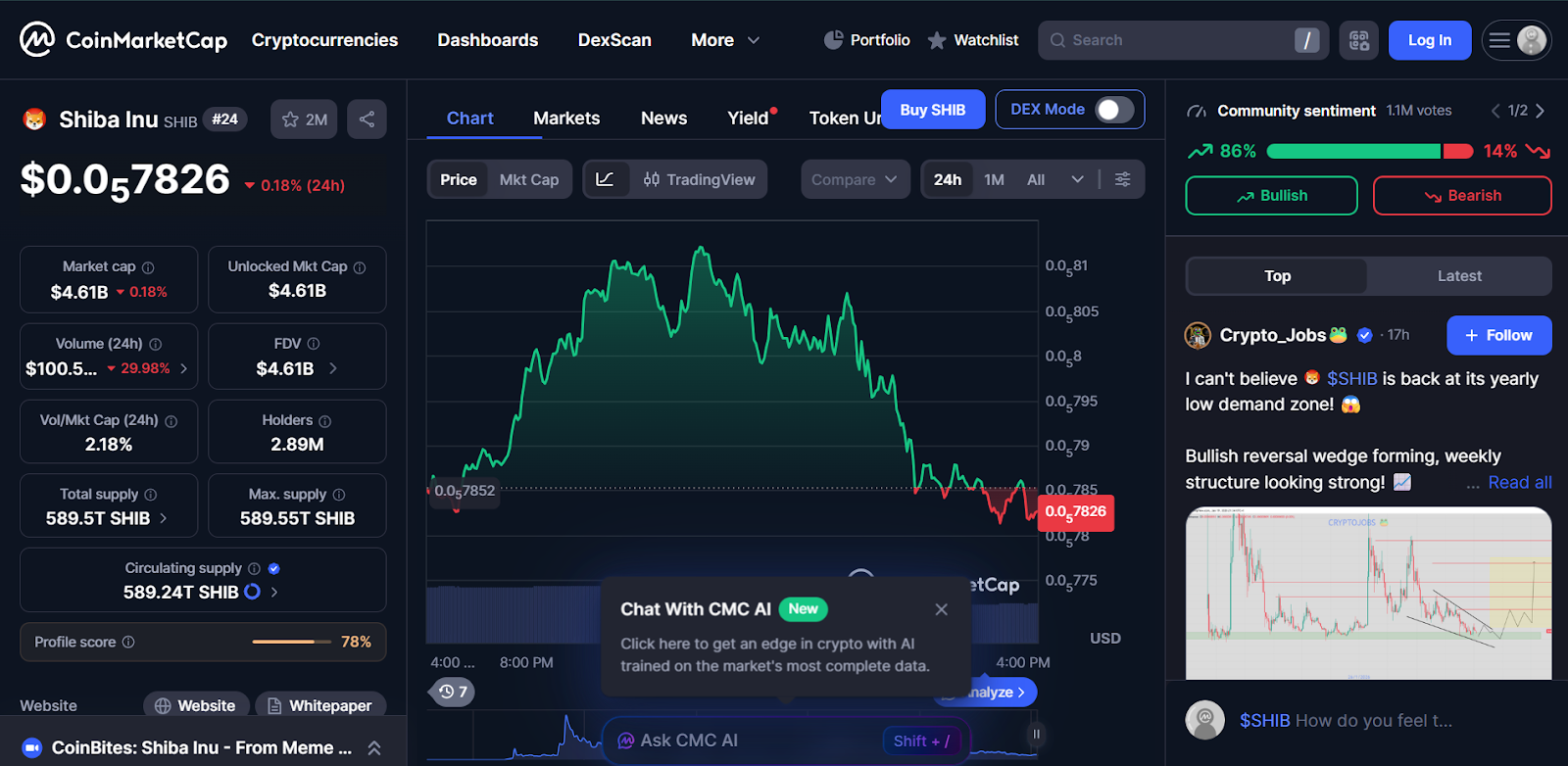
It’s very unlikely that the Shiba Inu coin will reach $1 in 2030. In 2026, SHIB trades at around $0.00000807. To reach $1, the price would need to increase by more than 120,000 times. That would require a compound annual growth rate (CAGR) of roughly 940% every year for the next five years, which is an extremely high bar for any asset.
There are also about 590 trillion SHIB tokens in circulation. At $1 per token, that would put Shiba Inu’s total value in the hundreds of trillions of dollars. That figure is far beyond what any cryptocurrency has ever reached and much larger than the world’s biggest economies. For comparison, the U.S. economy, the largest globally, recorded about $30 trillion in GDP in 2025.
The Future of Shiba Inu
Several developments are shaping what lies ahead for Shiba Inu:
- Shibarium upgrades: Recent upgrades gave Shiba Inu’s developers new tools for building apps and DeFi projects. These improvements have boosted daily transactions and increased SHIB burns.
- Token burns and governance: SHIB’s burn rate has increased recently. The goal is to reduce supply and make the remaining tokens scarce.
- Privacy enhancements: In 2026, Shibarium plans to integrate private transactions, making it safer for users and potentially more attractive to institutional players.
- Security strengthening: After a $4 million exploit in 2025, Shibarium is strengthening its security. Key measures include audits, bridge safety updates, and improvements to validators. These steps are essential for trust.
- Shib alpha layer: Launched in 2025, this Layer-3 solution enables faster payments and easier app development on the Shibarium network. Its success depends on overall Shibarium adoption and competition with other blockchain networks.
While burns and upgrades could tighten supply and strengthen the community, broader market conditions and adoption will ultimately determine its long-term trajectory.
Conclusion – Should You Invest in Shiba Inu in 2026?
Investing in Shiba Inu in 2026 comes with both opportunities and risks. You could see big gains, but sharp losses are possible too. SHIB has a strong community, a growing ecosystem, and wide recognition. At the same time, price swings and uncertainty about long-term value are real challenges.
If you understand the risks and are comfortable with uncertainty, SHIB could be worth exploring. If you prefer steady, predictable returns, it may not be the right choice. Always do your research, invest only what you can afford to lose, and keep your expectations realistic.
FAQs
The purpose of the SHIB token is to power the Shiba Inu ecosystem. You can use it for trading, staking on ShibaSwap to earn rewards, or making payments in supported stores. SHIB also enables faster, cheaper transactions on Shibarium.
Shiba Inu and Dogecoin work differently. SHIB runs on Ethereum, giving it access to smart contracts, DeFi apps, and NFTs. Dogecoin runs on its own network and is mainly used as a digital currency. If you value ecosystem features and community projects, SHIB offers more options. For simplicity and long-term recognition, Dogecoin has the advantage.
It’s extremely unlikely that SHIB will reach $0.01 given its current supply. With over 590 trillion tokens in circulation, reaching that price would require an unrealistic market value far bigger than the global economy. Even with burns and adoption, hitting $0.01 would require massive growth, which is highly improbable over the next few years.
The Shiba Inu coin is used in many ways. You can trade or hold it as an investment, stake it on ShibaSwap to earn rewards, use it for payments where accepted, buy and trade NFTs like Shiboshis, and interact with games and the Shibarium Layer-2 network.
Shiba Inu can be a high-risk, high-reward investment. Its value depends on community growth, ecosystem adoption, and market sentiment. It might appeal to investors comfortable with volatility who want exposure to other meme coins with real ecosystem features. It may not suit those looking for stable or predictable returns.