
Key Takeaways:
- Netblocks reports Iran’s 50-day blockade slashed connectivity to 2%, spurring $1.8B in economic losses.
- Blocked from the internet, Iranian citizens now face $5,000 Starlink prices and costly VPNs to bypass ongoing censorship.
- Parliament’s Fazlollah Ranjbar opposes restoring access and supports the ongoing digital blackout.
1,176 Hours Without Internet Connectivity: Iran Enters 50th Day of Digital Blockade
While some advancements have been made in the current negotiations between Iran and the U.S.-Israel coalition after the ceasefire was reached, this has not included the ongoing digital blockade situation affecting almost all Iranians.
According to Netblocks, an internet observatory, Iran’s internet connectivity remains at critical lows as the digital blockade enters its 50th day, meaning Iranians have endured over 1,176 hours of complete disconnection.
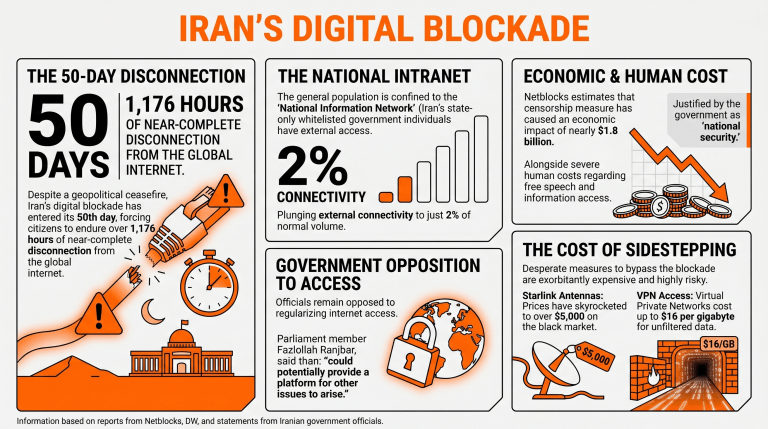
Almost all of the population is now confined to the National Information Network, Iran’s intranet, while whitelisted individuals linked to the government can still reach outside the national digital wall. Connectivity has been reduced to 2% of its normal volume, even as reports indicate that some users have been able to access Google’s home search page and some of its services.
The blockade, which has been justified by Iran’s Foreign Minister Abbas Araghchi as a matter of national security to “protect the people,” has caused millions in losses for the Iranian economy. Netblocks estimates that the measure has had an economic impact of nearly $1.8 billion in addition to the human cost of censorship.
The situation is unlikely to improve in the short term, as government officials have voiced opposition to regularizing internet access to the general population. On April 17, Fazlollah Ranjbar, a member of the Iranian Parliament’s Social Commission, stressed that “it may not be expedient for the internet to be accessible under such conditions, as it could potentially provide a platform for other issues to arise.”
At the same time, using alternatives such as Starlink, which can be punishable by the regime, has become more difficult, with prices skyrocketing to over $5,000 in the black market. Similarly, virtual private networks that can sidestep the blockade cost up to $16 per gigabyte of unfiltered access, per DW.